
What's New Under The Sun

Thursday, 28 May 2026 22:31

A wonderful trio of solar eclipses on the Iberian Peninsula will occur.  The first will occur on 12 August 2026 with viewing time of more than 2 minutes. lThe second, almost exactly a year later on 2 August 2027, will be even more spectacular, with an eclipse duration of 4 minutes.  On 26 January 2028 Spain will encounter an annular solar eclipse, creating a view of the rim of the sun...

Thursday, 07 May 2026 20:28

In August, 2009 the NASS Conference was held in Portland, Oregon and visited the sundial at Clark College in Vancouver, WA.  The equatorial sundial, built in 1984, had just received a new gnomon: an analemmatic or "bowling pin" gnomon that corrects for the Equation of Time. On May 4th, 2026 the local newspaper of Clark County, the Columbian, reported that more than 40 years after its...

Tuesday, 21 April 2026 16:47

Heritage Auctions of Dallas, Texas, is auctioning a brass dial signed by "Patrick Hepburn, Marlborough, Maryland, 1720"..  The dial face has a rich green patina with rough but accurate engraving of Roman numeral hours, delineated with half, quarter and eighth hour marks. The dial has an eight point compass rose with lettered points.  Latitude is engraved as "LATT 39".The wide, but...

Sunday, 12 April 2026 21:30

Do you wonder what a Bifilar Sundial is? Or a Campbell-Stokes Recorder? Maybe you are studying facts about astrolabes and come across the word almucantar.  Are they rings in the sky? Our perhaps you want to make a vertical dial and need the trigonometric formula to draw the hour lines and have forgotten where to look.  All of these questions can be answered plus internet and NASS...

Monday, 06 April 2026 01:08

The Times Colonist in an article of March 28, 2026 by Hannah Link, reports that as of November 2026, British Columbia will change to permanent daylight time.  "That means sundials in B.C. will always be one hour behind, no matter the time of year, said Victoria-based sundial enthusiast Steve Lelievre." Photo: Times Colonist - The sun shines on the Sundial Garden in Beacon Hill...

Monday, 09 March 2026 15:10

Building on the success of the 2025 inaugural event celebrating world sundial day on March 20th, 2026. This global online gathering celebrates sundials, timekeeping, astronomy, history, art, mathematics, craftsmanship, and cultural heritage across the world. World Sundial Day was originally created by Esteban Martínez Almirón on his website Reloj Andalusí. World Sundial Day is celebrated...

Thursday, 22 January 2026 18:30

UPDATE:  We will have a special tour of the Kentucky Viet Nam Memorial Sundial.  See the attachment about the construction of this wonderful memorial. Get ready to travel. This year the 31th NASS annual conference will be held in Louisville, KY at the Hyatt Regency Hotel June 25th - June 28th. The conference starts Thursday June 25th at 4:30pm with an opening reception, introductions,...

Monday, 13 October 2025 22:49

On October 4, 2025 Madison Historical Society of Ohio was able to have their sundial returned after 32 years, when in 1993 it was moved to the lawn of Lake County Courthouse to reduce the chance of vandalism. The sundial was originally placed at Madison Home 100 years ago on Saturday, October 24, 1925 during a conference of the Women's Relief Society.  From 1904 to 1962 the state ran this...

Monday, 15 September 2025 19:42

NASS is pleased to announce the upcoming fifth instance of Elements of Dialing, our introductory course about sundials, their history, and the science that makes them work. The free 12-lesson course, intended for those are new to sundialing, runs from 27 October 2025 until 26 April 2026. The course instructor is Robert Kellogg, NASS Vice President and Sundial Registrar.  Bob will be...

Thursday, 11 September 2025 23:11

A Hungarian born American scientist, Mária Telkes (1900-1995), was called "The Sun Queen" and among other honors, was postmousthly inducted into the National Inventors Hall of Fame. She lived to 95 and for most of her life developed solar power in a variety of forms. Trained as a biophysicist, she worked for Westinghouse Electrical and Manufacturing Company in Pittsburgh, PA, where she...

Thursday, 28 August 2025 23:25

The annual NASS Conference was held 7-10 August, 2025 in Ottawa.  As usual, the conference began late Thursday afternoon with an introduction social and a "grab bag give away", taking your chances with tickets to win the bag's prize.  Will Grant was the final winner of the Walton Double Planar Polar Sundial, but Paul Ulbrich beat the statistic odds and won this prize three times,...

Tuesday, 10 June 2025 18:51

  Prosciutto di Portici (Ham) Sundial Photo: Getty Images The Prosciutto di Portici Sundial, more often called the Portici Ham Sundial, dates from the first century somewhere between  8 BCE to 79 CE.  This small silvered bronze dial was uncovered on 11 June, 1755 in the ruins of Herculaneum (current day Portici) in the "Villa of the Papyri", buried in...

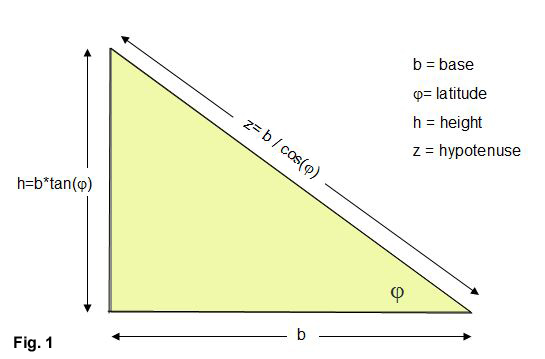
Part 3 Fig.1 Simple GnomonIn the March 2020 issue of The Compendium (Vol. 27-1) from NASS I discussed how to make a simple triangle gnomon.  We'll extend this tutorial to add a rounded tip and then examine how to make a gnomon with an underneath cut-back for a more pleasing shape.

The fundamental triangle has a base b, height h, and hypotenuse z.  To make the triangle proportions for the sundial latitude \(\phi\), we observe that the hypotenuse must point to the north (or south) celestial pole. As shown in (Fig. 1) :

    \(h =b*tan\phi \)
    \(z = \frac{ b}{cos\phi} \)

We'll start out making the gnomon in a self-contained OpenSCAD module that at first simply creates the gnomon in the x-y plane.  Here's the code:
lat    = 40;        //example dial is set at 40 deg north
b      = 35;        //gnomon base 35mm for 3D dial size of 75mm
gwidth = 2;         //gnomon width in mm
gnomon(lat,b,gwidth);                   //main procedure call
 
module gnomon(lat,b,gwidth){
      h  =  b*tan(lat);                 //height of  gnomon
      gpoly = [[0,0],[b,0],[0,h]];      //simple triangle [x,y] points
      // extrude gnomon in xy plane
      linear_extrude(height = gwidth, convexity=3)
      polygon(gpoly);                   //make polygon from points
}

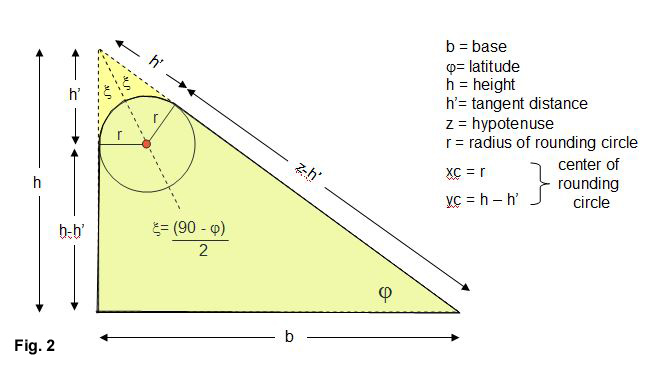
Part 3 Fig.2 Gnomon with Rounded Tip

In the full code, we'll rotate and translate the gnomon so that it sits on top of the sundial we've designed inthe previous tutorials.  But first, let's improve the gnomon with a rounded tip.  From Fig. 2 we see that the rounding circle is centered on a bisected line from the apex and is tangent to both triangle's vertical and hypotenuse sides.  We've labeled the tangent distance from the apex as h' on these sides. If we specify the rounding circle's radius r we see that the apex triangle half-angle \(\xi\) can be derived from the sum of angles equal to 180 degrees.  Rearranging we get:

    \(\xi = \frac{90 - \phi}{2} \)
 
Next, we use the apex triangle and trigonometric identities to determine the tangent distance h' from the apex:

    \( h' = \frac{r}{tan\xi} \)

The x-y tangent coordinate on the vertical side of the triangle is [0,h-h'].  The x-y tangent coordinate on the hypotenuse is a bit more complicated, giving [b -   (z-h')* cos\(\phi\), (z-h')*sin\(\phi\)].  These points help create a 4-point polygon to which we add the rounding cylinder:
lat    = 40;        //example dial is set at 40 deg north
base   = 35;        //gnomon base 35mm for 3D dial size of 75mm
gwidth = 2;         //gnomon width in mm
gradi  = 3;         //radius of the rounding circle
gnomon(lat,base,gwidth,gradi);                //main procedure call
 
module gnomon(lat,b,w,gradi){
      h  =  b*tan(lat);                       //height of  gnomon
      z  =  b / cos(lat);                     //hypotenuse
      xi = (90 - lat)/2;                      //half apex angle
      hp = gradi / tan(xi);                   //tangent distance
      ho = h - hp;                            //lower vertical distance
      zo = z - hp;                            //lower hypotenuse distance
      zx = b - zo*cos(lat);                   //x-tangent point on hypotenuse
      zy = zo*sin(lat);                       //y-tangent point on hypotenuse
      cx = gradi;                             //x-tangent point on vertical
      cy = ho;                                //y-tangent point on vertical
 
      gpoly = [[0,0],[b,0],[zx,zy],[0,ho]];   //4-point polygon
 
      // extrude gnomon in xy plane
      linear_extrude(height = w, convexity=3)
      polygon(gpoly);                         //make polygon from points
 
      // add cylinder
      translate([cx,cy,0])
      cylinder(r = gradi,h = w);
}
 

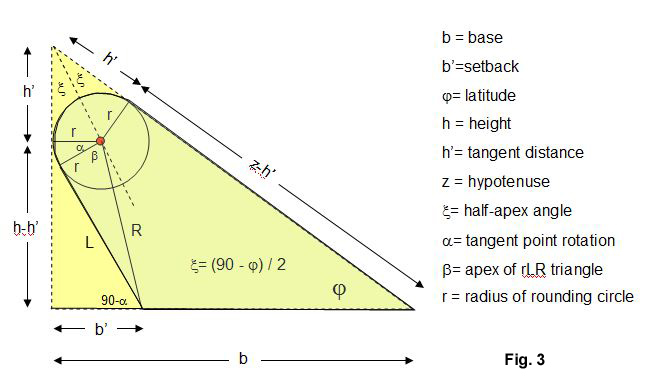
Part 3 Fig.3 Gnomon with Set BackNow let's go even further by using a setback of the base where we move the vertical portion of the triangle back underneath the hypotenuse.  The setback rotates the exact point of tangency with the rounding circle, so that we need a little more trignometry.  In Fig. 3 the new gnomon setback line is L.  To determine L we use the circle center to setback distance R as well as determining the apex angles alpha and beta:

    \( R=\sqrt{(b'-r)^2+(h-h')^2}\)

The length R and rounding circle radius give the apex angle \(\beta\):

    \(\beta = acos(\frac{r}{R})\)  and   \(L = R*sin\beta \)

All that remains is finding \(\alpha\).  We see that the side L is actually part of two triangles.  One is the rLR triangle with apex angle \(\beta\) and the other triangle is made from the setback b' and angle 90-\(\alpha\).  Two equations can be formed which after some algebra reduces to:
Part 3 Fig.4 Sundial with Gnomon    \(\frac{ (b'-r) - r*cos\alpha} {L}  = -sin\alpha\)
    \(\frac{ (h-h') - L*cos\alpha} {r } =  sin\alpha\)

Adding them together and rearranging

   \(cos\alpha = \frac{r*(r-b') + L*(h-h')  } {r^2 + L^2  }\)

With \(\alpha\) the indented tangent point is easily found as

    \(tx = r - r*cos\alpha\)
    \(ty = h' - r*sin\alpha\)

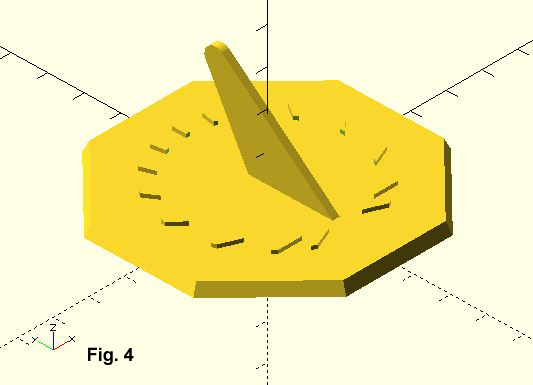
Pick up the attached OpenSCAD tutorial file and see the full code to attach either the simple, rounded, or setback gnomon onto you dial.  In the next tutorial, we'll add hour numbers to the dial.

 
Attachments:
Download this file (Sundials Part 3 - Add Gnomon.scad)Sundials Part 3 - Add Gnomon.scad[ ]8 kB