
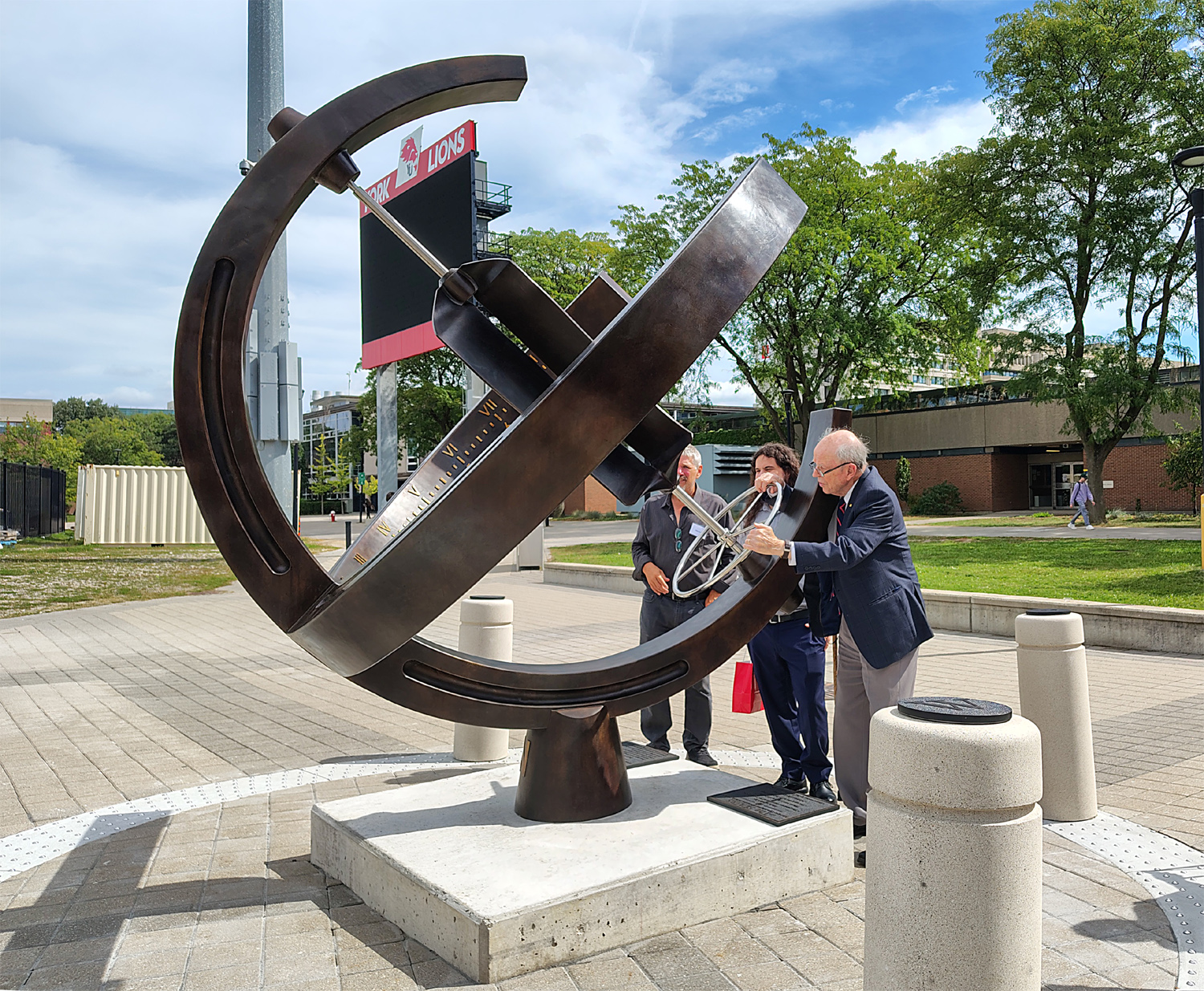
 Dr. Robert Stairs rotates the 200-lb (90 kg) gnomon to tell the time from a line of sunlight onto the equatorial ring. After nearly two years of design, engineering, and fabrication, a large 8-ft (2.4m) bronze Schmoyer-type sundial was dedicated on 16 September 2026 at York University in Toronto, ON. The dial was made possible by the generosity of Dr. Robert Stairs, once a student at York U. and now professor emeritus of Chemistry at Trent University. The sundial, called STAIRS, is an acronym for Schmoyer-Type Adapted Interactive Reliable Sundial.
The STAIRS design uses a gnomon that is not stretched at the solstices, and therefore does not require daily north or south movement near the weeks around the solstices. It remains interactive, requiring the observer to rotate the gnomon to face the sun. One gnomon flange shows the analemma shape for Dec 22 to June 21, and the other flange has the mirror shape for June 22 to Dec 21. This allows the sundial to tell accurate civil time.
The sundial project was engineered by Sea West and the tremendous undertaking of casting the bronze sundial (with interior steel supporting structure) was done by Artcraft, Inc.