
Trio of Solar Eclipses in Spain
A wonderful trio of solar eclipses on the Iberian Peninsula will occur. The first will occur on 12 August 2026 with viewing time of more than 2 minutes. lThe second, almost exactly a year later on 2 August 2027, will be even more spectacular, with an eclipse duration of 4 minutes. On 26 January 2028 Spain will encounter an annular solar eclipse, creating a view of the rim of the sun against the lunar silhouette that many call “The Ring of Fire”.
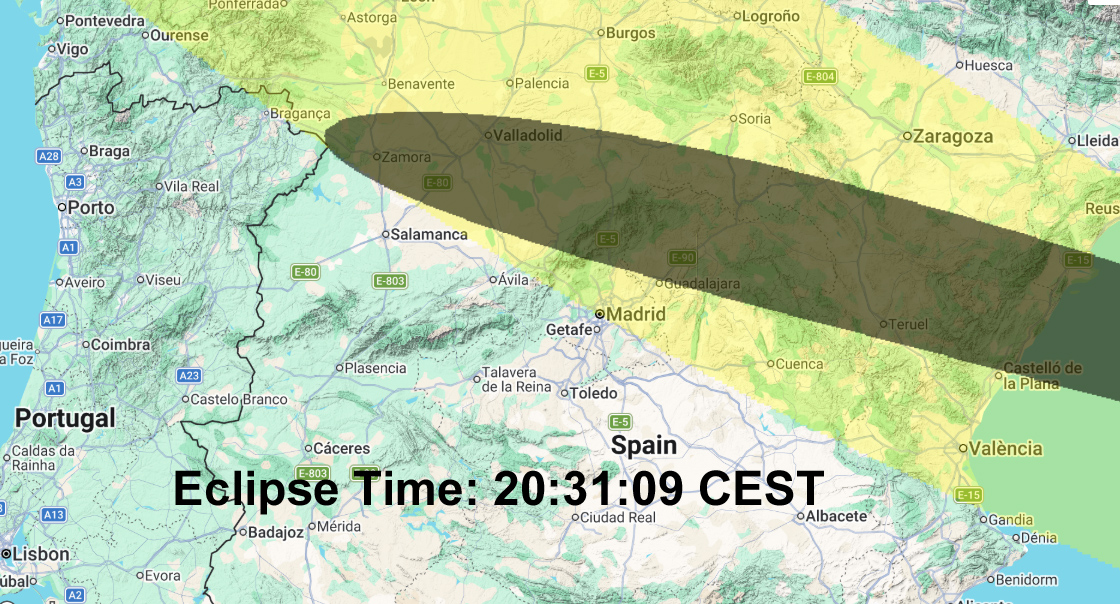 The eclipse expert of Fred Espenak lives on in spirit. From Manuel Pizarro, an NASS member, comes a unique map of the umbral and penumbral events of these three solar eclipses. He has created an app using the Google Earth Engine (GEE).
The app is based on "the rigorous astronomical algorithms of Jean Meeus and uses Besselian elements provided by NASA. All the geometric computational load—from the calculation of the shadow's path to the generation of the umbra and penumbra— was processed in real time on Google's servers, allowing for a smooth experience without overloading the user's device.To ensure its international reach, the interface is completely translated into Spanish, English, French, and Italian."
Visit: https://gee-astrolab.users.earthengine.app/view/solar-eclipse The App features and detailed instructions can be downloaded here:
 Google Earth Engine Map of Spain Solar Eclipses - Manuel Pizarro.pdf454.92 KB
Another important website mapping the eclipse is from the Instituto Geográfico Nacional: https://visualizadores.ign.en/eclipses/2026 (english)
This site of The Trio of Eclipses also includes a detailed and controllable topographical map of Spain that can be switched between the languages in Catalan, Basque, Galacian, Spanish and English.
Detailed eclipse information, including predicted weather can be found at https://eclipsophile.com/tse2026/
Don’t forget to wear your solar protective glasses until total eclipse begins, otherwise you can permanently damage your eyes.
- Details
- Hits: 1126
British Columbia goes on Permanent Daylight Time - 2026
The Times Colonist in an article of March 28, 2026 by Hannah Link, reports that as of November 2026, British Columbia will change to permanent daylight time. "That means sundials in B.C. will always be one hour behind, no matter the time of year, said Victoria-based sundial enthusiast Steve Lelievre."
From Ogden Point to Greater Victoria Harbour to the vertical dial at Christ Church Cathedral, sundials will be an hour off. "The sundial was installed at the [cathedral] in 2001 during renovations and is dedicated to the memory of Betty Whitlow, the wife of Rev. Brian Whitlow, who was dean of the cathedral from 1955 to 1980."
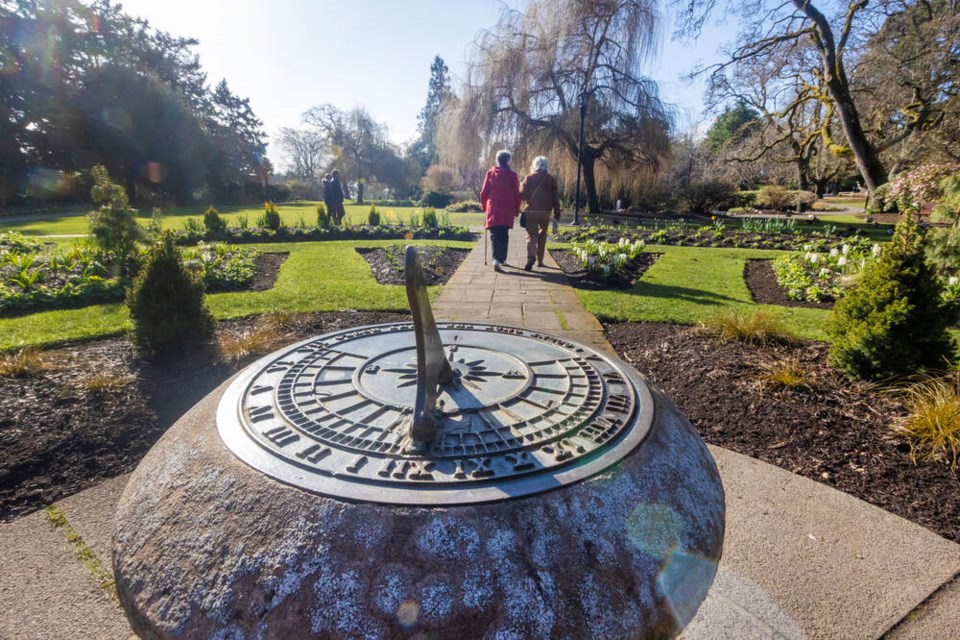 Photo: Times Colonist - The sun shines on the Sundial Garden in Beacon Hill Park. The circular garden features a bronze and stone sundial created in 1947 by the Royal Astronomical Society of Canada. Situated in the Rose Garden area, it displays solar time, with an inscription reading “I count only the sunny hours.” DARREN STONE, TIMES COLONIST Links continued in an interview with Steve Lelievre, "...he became fascinated with the Earth’s movement around the sun while gardening with a friend back home in the United Kingdom. The friend wanted to choose the right plants based on the sunniest areas of his yard, so he poked a stick in the ground and watched its shadow move. 'I was completely amazed by that and had to go away and figure out for myself how that could be,' he said. 'Once I got interested in that celestial mechanical stuff, I got interested in sundials. It’s kind of a natural progression.' "
Links also interviewed Vernon Miles is the great-great-nephew of William Willet, the English inventor of daylight time. "The 83-year-old learned about Willett and his invention as a child, and for most of his life, it’s been a fact he uses to poke fun at his friends when they complain about having to change their clocks....Miles said he would have preferred that B.C. move to permanent standard time instead of daylight time. 'I chuckled to myself,' he said. 'My uncle will forever turn over in his grave.' "
Read the full article at: https://www.timescolonist.com/local-news/will-sundials-be-adjusted-for-year-round-daylight-savings-only-time-will-tell-12066472
The transition to permanent DST actually began Sunday, March 8, 2026 according to the B.C. government. Now there is no turning back the clock on November 1st. Under the Interpretation Amendment Act, B.C. government adopted permanent year round daylight saving time (DST) "to improve people's overall health, reduce disruptions for families, simplify scheduling and provide an extra hour of evening light during the winter months." Certain locales have exceptions such as "People in southeastern B.C. (East Kootenay and Golden region) currently switch between mountain standard time and mountain daylight time, in line with Alberta."
See: https://www2.gov.bc.ca/gov/content/governments/celebrating-british-columbia/daylight-saving-time for a complete description of the conversion to permanent daylight saving time for British Columbia.
- Details
- Hits: 1083
Pros and Cons of Daylight Savings Time
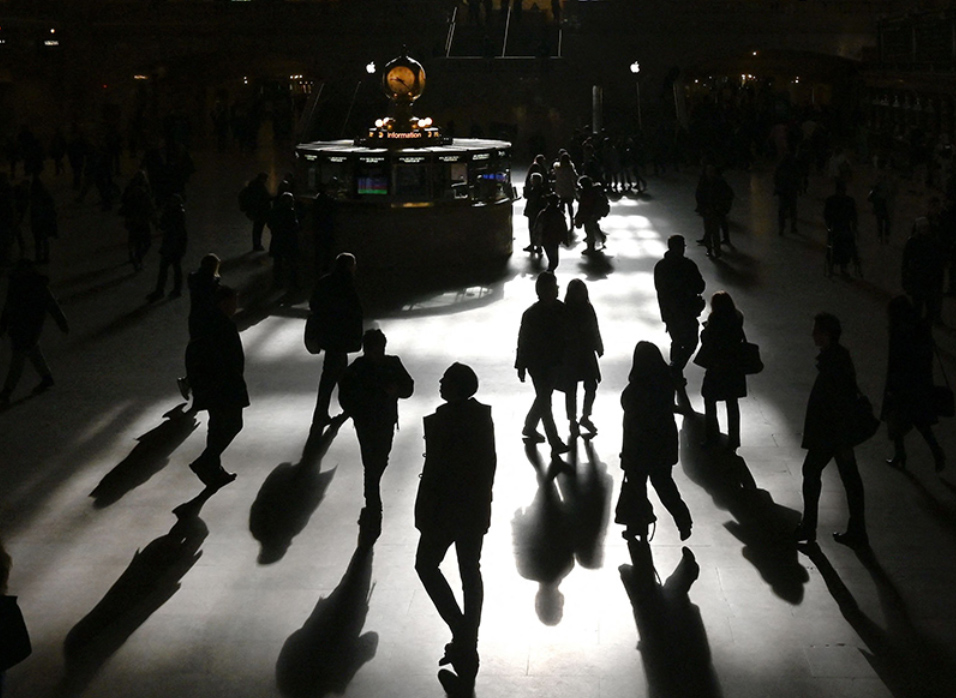 Photo credit: Timothy A. Clary/AFP via Getty ImagesIn a 24 March 2025 article from the on-line Science Advisor (American Association for the Advancement of Science) Phie Jacobs summarizes the "great debate" of the yearly shift from standard time to daylight savings time. In January 2025 the US Senate introduced the Sunshine Protection Act to permanently have daylight savings time year round. Certainly 54% of Americans do not like the annual migration from standard to savings time and back. In the US, daylight savings time was instituted in 1918 during World War I.
"José María Martín-Olalla, a physicist at the University of Seville and lead author of the new position paper, argues that seasonal clock changes also represent a practical solution to a broader problem: reconciling the fixed, clock-driven schedule of modern life with sunrise times that vary throughout the year."
Jacobs points out that numerous studies have linked time-related sleep disruptions to increases in heart attacks, strokes, traffic accidents, and workplace injuries, and sleep researchers strongly oppose that idea on the basis that extra-dark mornings and extra-bright evenings would dangerously disrupt people’s sleep. Many medical and scientific organizations instead advocate for permanent standard time.
Jacobs sees a middle point, saying that according to Fong-Isariyawongse, human biology functions according to light exposure and people’s circadian rhythms already naturally adjust throughout the year. “Instead of manipulating clocks,” she says, “a better approach would be to allow workplaces and schools more flexibility in adapting schedules based on natural light conditions.”
There is no easy solution. Maybe the middle ages had it right using unequal time.
Read the full article at: https://www.science.org/content/article/scientists-weigh-pros-and-cons-daylight-saving-time
- Details
- Hits: 2431
Moon Time Using an Analemmatic Sundial
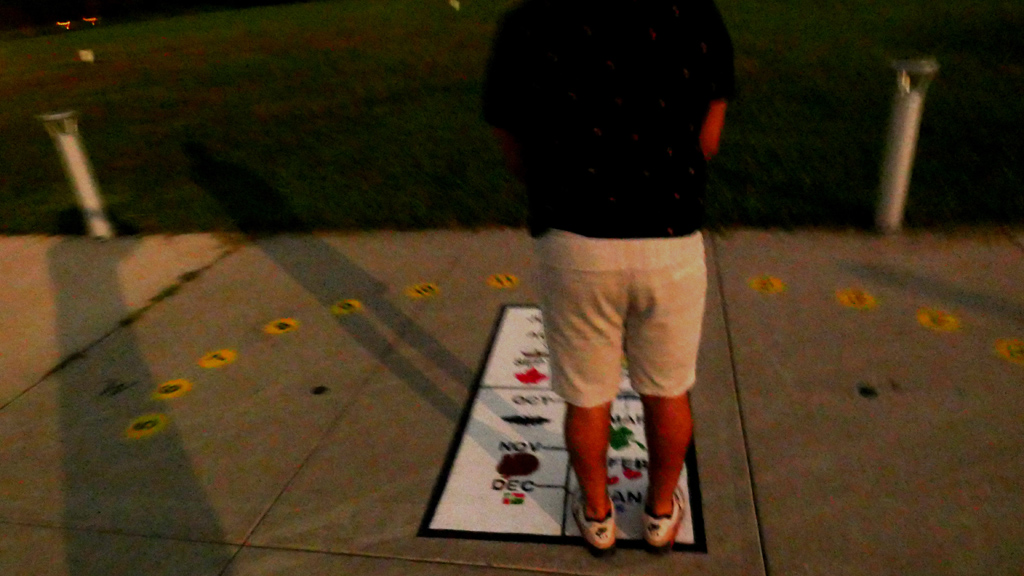 By the Light of the Moon - Photo by Dr. Jeff KretschThe analemmatic (human) sundial at Turner Farm Observatory Park in Great Falls, VA made by Eagle Scout candidate Kenny Dieffenderfer and Troop 1547 marked a unique place in sundialing history this July 23rd. The Analemma Society sponsors free Friday night public viewing of the heavens through telescopes at Turner Farm's Roll-Top Observatory. But just outside the Observatory on the sidewalk is Kenny's analemmatic dial. Could this dial tell correct time by the light of the moon?
On July 23rd this question was put to the test. It was almost exactly a full moon and the sky was clear. As can be seen in the accompanying photo taken by Dr. Jeff Kretsch at approximately 10:10pm EDT, the lunar shadow of a volunteer human gnomon cast a shadow of about 9:10pm standard moon civil time. How did this come about?
The important facts needed to make the analemmatic dial tell the correct "moon time" is knowing both the phase of the moon and the declination of the moon. On that night the moon was very close to being exactly a full moon and the declination of the moon was 25 degrees south of the equator. The maximum that the sun ever gets is 23.45 degrees south of the equator at the winter solstice. That means that (with practical precision) even though it was a late July night, the human gnomon must stand on the dial's zodiac walkway at the Dec-Jan winter solstice mark.
If this were the sun, we apply a plus 8 minute correction for the 77 deg west longitude of the observatory. The moon gets the same treatment. But what about the moon's phase and the "equation of time"? Here we find a fortunate coincidence: The moon was full moon at 10:37pm EDT on that Friday night, so by luck the moon was almost exactly opposite the sun. The moon's average full moon to full moon (a synodic month) is 29.53 days. Thus the average moon's lead or lag of a mythical full moon is about 49 minutes per day. Therefore the lunar phase correction is approximately 49 x 20/1440 = 0.68 minutes (41 seconds) ahead of the average full moon. Finally the sun's EOT for Friday July 23rd is approximately 6min 30 sec to be added to a dial's shadow to get civil time. But the moon opposite the sun has EOT in the opposite direction of minus 6min 30 sec. The net lunar correction is therefore +8.0 -.68 -6.5 = 50 sec, just less than one minute that needs to be added to that night's observation analemmatic shadow. One might say that the moon and sun were in perfect alignment!
- Details
- Hits: 7509
Celebrate the Spring Equinox From Your Home-2020
 Here in Great Falls Virginia on the day of the Spring Equinox, March 19th, it's a rainy day. Perhaps that helps us want to stay inside with all of the travel and meetings restrictions imposed because of the Covid-19 virus. However, astronomical events aren't deferred because of human and biological issues. Late today the sun crosses the celestial equator and heralds in Spring. You can observe this event remotely thanks to Lowell Observatory in Arizona. Lowell Observatory will begin Live Streaming the event starting at 9pm EDT. "The spring equinox in 2020 occurs on Thursday, March 19 at 8:49pm MST/PDT (3:49am GMT), when the Earth's axis is exactly perpendicular to an imaginary line drawn between the Earth and Sun. On the equinox, the Sun rises due east, and it sets due west, no matter where you are on the Earth."
https://www.youtube.com/watch?v=LqP1Md85HHs&feature=youtu.be
- Details
- Hits: 10942
2018 Sundial Calendar
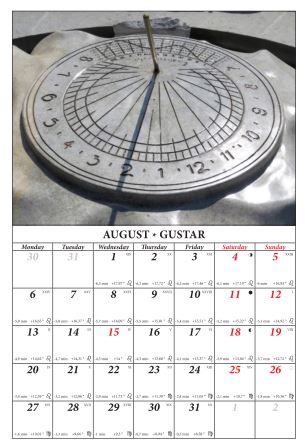 Dan-George Uza has prepared a calendar for 2018 "containing images of Romanian sundials and some daily astronomical information (the equation of time, the Sun's declination angle & zodiac sign, the Moon's phase & age etc.).... The calendar reflects the usual Romanian practice of starting weeks on Mondays, being the first working day, although orthodox religious calendars have reverted to starting weeks on Sundays due to religious reasons since 2011. The days of the week have been translated to their English counterparts for your convenience. Apart from the last two, which have different etymological background, they all closely follow the names of the ancient planets" Luni - Luna (Moon), Marti - Marţe (Mars), Miercuri - Mercury (Mercury), Joi - Joe/Jupiter (Jujpiter), Vineri - Venus (Venus) Sámbătă - from the Latin sa(m)bbatum meaning Sabbath, Duminica - from the Latin (dies) Dominica meaning day of the Lord. .... You may download the English version at the link below:"
Dan explains that the calendar " includes a brief introduction to the Romanian calendar, such as an explanation for the names of the days and months, the dates of national holidays etc. This is actually my second calendar. I did the first one last year inspired by Fabio Savian's French Republican Calendar. A big thanks goes to Patrick Powers who was kind enough to correct my spelling mistakes for this English edition."
"The astronomical data was generated in Sun Ephemeris, Gian Casalegno's excellent software. The calendar is freeware so you may of course share it. It's intended for A3++ size paper (330x483mm) but I guess simple A3 will do."
"Have a Happy New Year or - as we like to say in Romanian - La Multi Ani!"
- Details
- Hits: 13939
- Perryville Eclipse Sundial - 2017
- Solar Eclipse Sundial
- NASS Observes Eclipse in St. Louis
- US Postal Service Issues Eclipse Stamp
- Tour of Time
- Sundials and Timely Ceremonies
- ...until the last syllable of recorded time
- Greenwich Globe
- A History of the Sky
- Virtual Art for Inventor of Standard Time
- 2012 Transit of Venus
- Sundial WebCam In Action