
Analemma and the Equation of Time
This Sundials for Starters appeared in The Compendium in December 2013
Robert L. Kellogg, Ph.D.

Fig. 1 Analemma over the Acropolis photographed during the year by AyiomamitisAs the shadows grow longer and we head for the winter solstice my mind turns again to the analemma, a concept invented by Grandjean de Fouchy in 1740 to describe the apparent irregular motion of the sun. Strictly speaking, this is the difference between the right ascension of the true sun minus the right ascension of the mean sun. While this is mathematically important to astronomers, it is esthetically pleasing that the apparent sun will describe a “figure 8” through annual motion in the sky. This “figure 8” or analemma is visible only when the sun’s position is compared to a “mean time” using a precise clock. The analemma (or the sun’s apparent East-West motion called the Equation of Time) allows us to answer the question “Will the time shown on my sundial be fast or slow compared with my watch?”
The result of all this motion is the analemma. Figure 1 shows the sun’s analemma in the sky as photographed by Anthony Ayiomamitis shown against the ancient Greek Acropolis.[1] His collection of analemma photographs over Greek ruins shows that they can be “constructed” at any time of day as long as you are consistent about the time.
The analemma is the confluence of (a) the seasonal migration of the sun from summer solstice at the Tropic of Cancer (when the sun’s excursion along the ecliptic takes it to +23.45north of the equator) to winter solstice at the Tropic of Capricorn (when the sun is at -23.44south declination); (b) the projection of this migratory path on the earth’s spinning equator. At the solstices, the sun’s motion is parallel to the equator and its motion appears fastest. When the motion of the sun is slanted at +/- 23.45º angle as it crosses the equator at each equinox, it’s projected motion on the equator is slowest. So twice a year the sun seems to accelerate then fall behind by +/- about 10 minutes.; and (c) Kepler’s famous the third law of motion requires an equal area of the earth’s orbital arc to be swept out in equal times. Hence at winter when the earth is near perihelion (on Jan 04 06:03 UTC on January 4th, 2014) it moves faster and farther in its orbital arc. Consequently it takes the sun longer to move from solar noon to solar noon. This creates a time swing of about +/-7 minutes through the year as the earth speeds up at perihelion and slows down at aphelion.
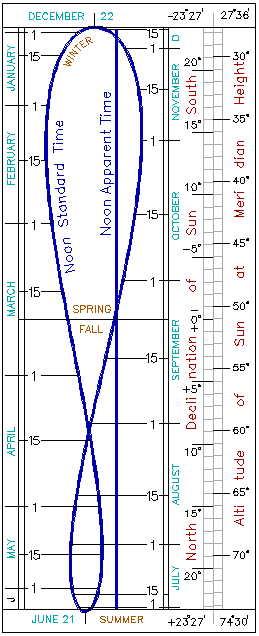 Fig. 2 Analemma from the Briggs Sundial located at the National Institute of Science & Technology
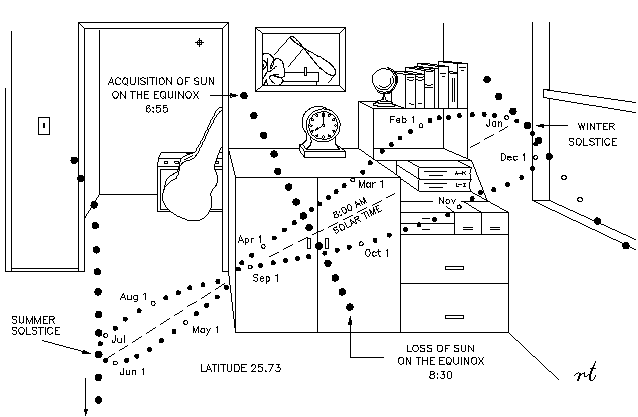 Fig. 3 Schematic of Analemma at the office of Robert TerwilligerWhen the sun’s shadow is cast on a sundial or the sunlight is projected as a beam of light from a mirror one needs to remember to properly invert the analemma projection. For example, Figure 2 drawn by Bob Terwilliger, shows the analemma for the Briggs dial located 8 minutes west of the Eastern Time Zone meridian.
You never really see the analemma since you need to compare where the sun is in the sky (or its shadow on the ground) with a uniform running clock (sometimes referred to as the “mean sun”). This means that you need to observe the sun at the same (standard) clock time each day. This is not a feat for the intrepid. Here are several tales:
In the fall of 1995 Bob Terwilliger moved to a new home where his office had a large east-facing window through which the sun came each morning. Bob recalls:
“At first I found this annoying, but then I realized I could take advantage of the situation and project an 8:00am analemma which would demonstrate the Equation of Time. Preliminary observations indicated that the analemma would wind its path across the walls, furniture and floor on the west side of the room…. I mounted a cardboard arrow high on the east window for a gnomon. At precisely 8:00 in the morning I placed a small paper dot where the shadow fell. My first dot was placed on the 1995 winter solstice. During the winter and spring the analemma snaked its way across the north wall, through a bookcase and onto a filing cabinet on the west wall. [See Figure 3.] The morning of the vernal equinox was clear and sunny. I placed dots at 5 minute intervals following the path of the shadow as long as the sun entered the room.”
“I realized from the position of the equinox line that I was in for some damage control. An eave overhanging the window was going to block the sun during high summer. Also, the point where the loops of the analemma crossed was going to come right where the shadow dropped off the filing cabinet and into the closet. I decided to plot the smaller, summer loop with a second gnomon 10 inches below the first. This enabled me to plot the loop and also moved it out into the room. The effect of lowering the gnomon is not obvious in the drawing.”
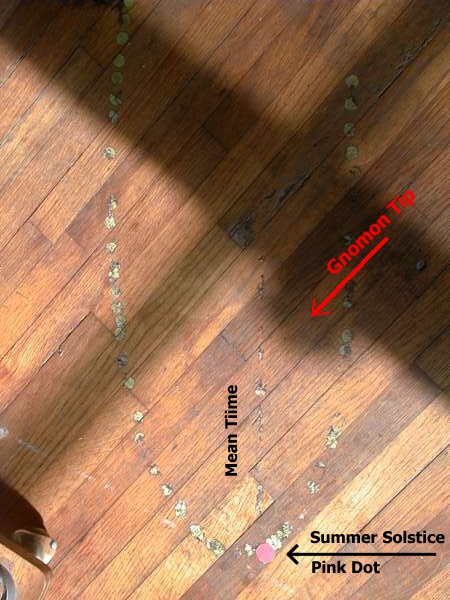 Fig. 4 Marking the Analemma on the Floor near Solstice“On the morning of the summer solstice, I again traced the path of the shadow, this time into and out of the closet, then across the floor. [Figure 4] shows the small loop taken a few days after the summer solstice. The photo also shows a portion of the path of the summer solstice shadow as it moved across the floor.”
The Universalist Unitarian Church in Sterling Virginia recently used a spot of sun reflected from a mirror to plot the analemma at the beginning of their service through the seasons [NASS Registry #778].
But perhaps the task of patiently plotting the sun’s annual journey is best told by Professor Woody Sullivan using a small mirror to reflect sunlight onto his kitchen more than 20 years ago: [2]
“I marked the ceiling for only a single time each day [choosing the time of 11:45am [Pacific Standard Time]. The overall size of the resultant analemma is proportional to the distance of the mirror below the ceiling… My first observation was on 26 March 1992 and as the weeks passed and the sun steadily moved higher, the reflected spot on the ceiling moved closer and closer to the window. But at three weeks before the summer solstice I ran into a serious problem – despite my calculations, the gutter was now shading the mirror!! Should I toss out ten weeks of good data and start over with a relocated mirror? No -- instead, drastic action was called for. For the next six weeks I climbed a ladder outside and held the gutter away from the house (allowing the sunlight to pass through the gap thus created) while an accomplice inside (my older daughter, who was well experienced in humoring Dad’s wacky projects) marked the ceiling!”
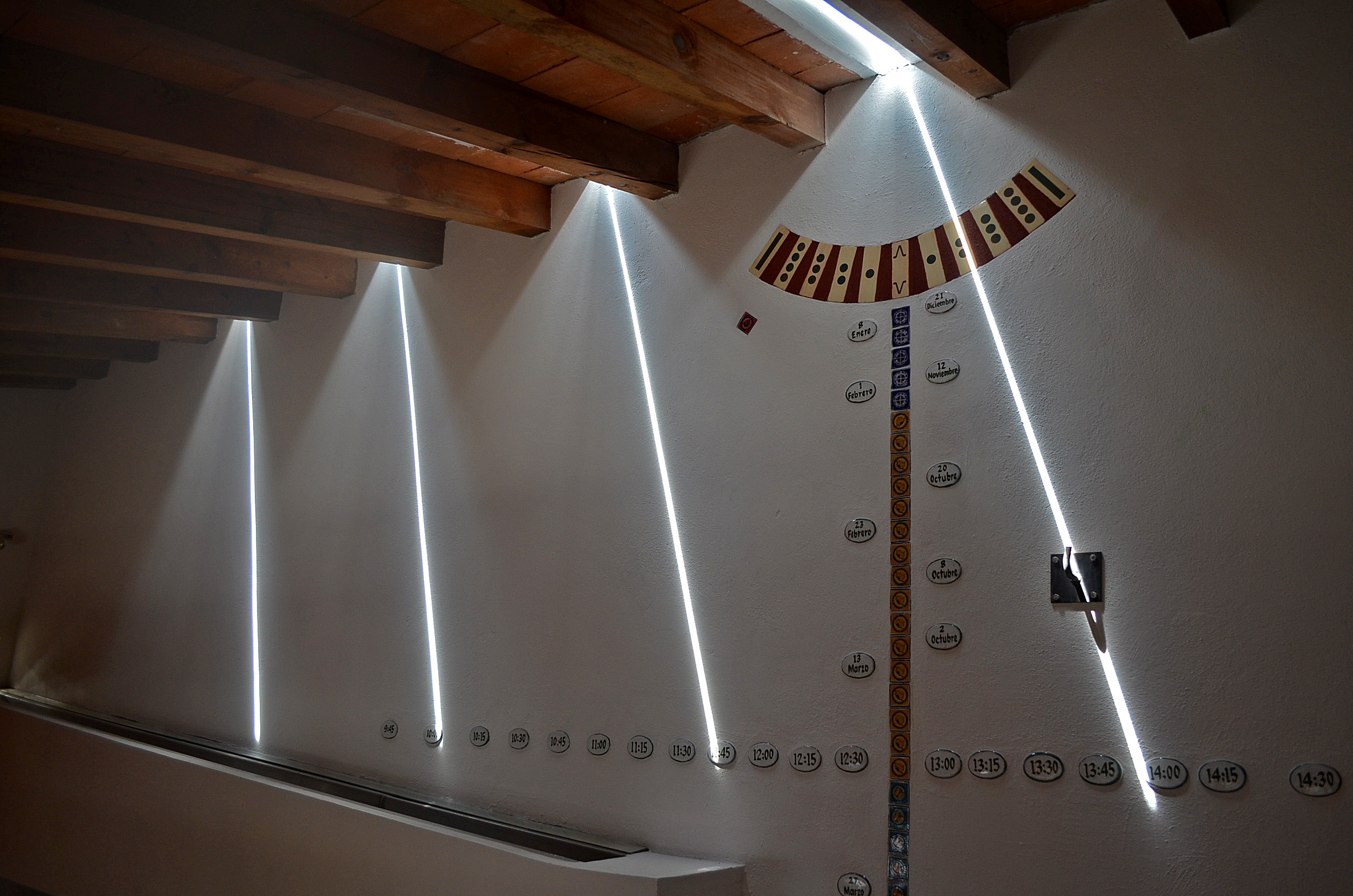 Fig. 5 The Cosmic Room ofRuben Nohuitol in Queretaro, Mexico
The most dedicated of them all is Ruben Nohuitol and his sundial house in Queretaro, Mexico. [Figure 5.] Beaming sunlight through the roof, he creates a striking sundial in the “Cosmic Room” of his casa decampo [NASS Registry #768]. A single spot of sun is marked every 3 to 5 days on the floor, again using the ubiquitous circular paper stick-on dots. The repeating analemma from year to year does not occur in the same spot on the floor because of the advance of the solar (tropic) year of 365 ¼ days versus our calendar of 365. Although the cycle repeats every four years, each year the spot intersects the analemma at a slightly different place.
So grab those paper stick-on dots and take on a year-long project to mark off the sunbeams or shadows to create you own analemma.
1Ayiomamitis http://www.perseus.gr
2 Woody Sullivan, “A Kitchen Ceiling Analemma”, The Compendium Vol 3 No. 1 March 1966 pp. 18-21
- Details
- Hits: 42092
A Matter of Longitude
This Sundials for Starters appeared in The Compendium in March, 2006
by Robert L. Kellogg, Ph.D
I usually get up at 7am (ante meridian), but unlike ancient farmers, the time of rise has almost nothing to do with sunrise. One June 21st, and just west of Washington D.C. my sunrise occurs at 5:43 am Eastern Daylight Time (EDT). That would be 4:43 am Eastern Standard Time (EST) if we left our clocks alone. I’m almost due west of Washington D.C. and the Ellipse in front of the White House. Interestingl, my sunrise will occur about 44 seconds after sunlight rises on the White House. How does this relate to longitude?
- Details
- Hits: 18043
Sundial Latitude
This Sundials for Starters appeared in The Compendium in December, 2005
by Robert Kellogg, Ph.D.
This is the start of a regular column to review the basics of Sundials. Of course NASS provides an introductory CD disk on sundials and there is always the classic reference Sundials, Their Theory and Construction by A.E. Waugh.
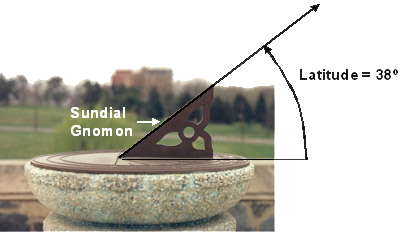
For this article, let’s consider some basics in buying a sundial for the garden. Or perhpas you want to make one. There are magazine catalogs and websites that offer “fine English dials”. But are they for you? Consider the latitude of an English dial. London is at about 51º north latitude, while most of the populated area of North America is below 45º. Take a look at the gnomon of your potential purchase. The gnomon should be approximately the same angle as you latitude. Here we’ll illustrate a dial (Figure 1) from the Naval Medical Center in Bethesda, Maryland with latitude of approximately 38º.
- Details
- Hits: 25752

Manhattan Henge
Fig. 1 Manhattan Henge at 42nd Street
One of the more interesting news items over the last several months has been the “Manhattan Henge” craze. Neil deGrasse Tyson, director of the Hayden Planetarium in New York, calculated the alignment of the sundown the street corridors of Manhattan (Fig. 1). For New Yorkers, two opportunities for alignment occur. The streets are aligned 28.9° east from North, and the sun sets near this at this azimuth on May 30-31 and July 11-12.
These alignments are just a small part of “shadow planes” where the shadow of the sun aligns with a building, wall or other object. The best description of shadow planes comes from the NASS expert, Mac Oglesby and his compatriots William Maddux and Fer deVries in a series of three articles in The Compendium.[1]
- Details
- Hits: 18865
Banneker - Drawing a Dial
By Robert L. Kellogg, Ph. D.

Benjamin Banneker, 1731-1806 , is one of the nation's best-known African American inventors. He was born in Maryland and in 1791 played an important part in surveying the newly designed Federal Territory, now called the District of Columbia. In his youth, Banneker was inspired to build his own clock after an acquaintance gave him a watch. He took the watch apart to find out how it worked and made drawings of each component, and based on his drawings, he carved larger versions of the components out of wood and constructed a clock that kept accurate time for more than 50 years. As mathematician, he designed an Almanac that was a rival of Benjamin Franklin’s famous publication.
As astronomer, clockmaker, and mathematician, he was expected to know how to design sundials, although none exist bearing his mark. In an age before pocket calculators, how would Banneker design a sundial? The graphical method is available in modern texts such as Waugh’s 1973 classic “Sundials: Theory and Construction”. Want to lay out a horizontal sundial without sines, cosines, and tangents? Then this “Sundials for Starters” is for you.
 Banneker- Dial Construction.pdf1.97 MB
- Details
- Hits: 13842