
1720 American-Made Brass Sundial up for Auction
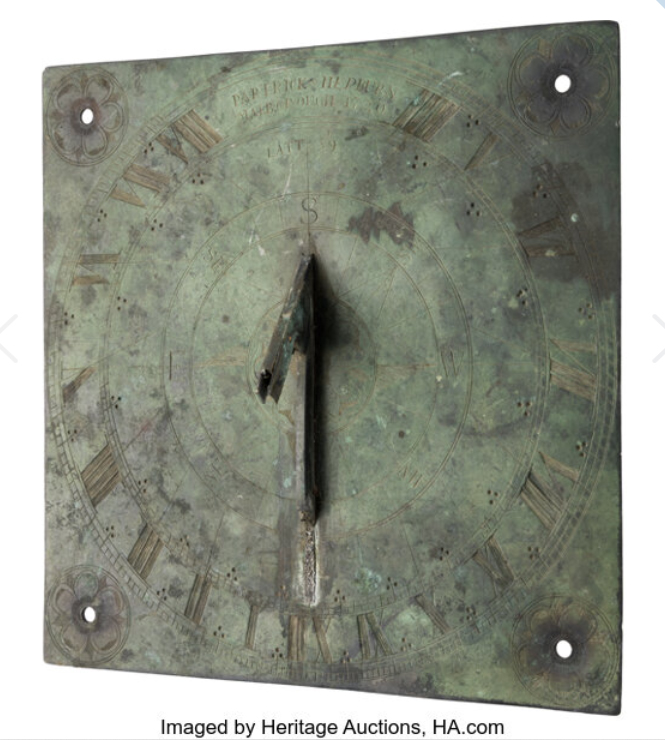 Heritage Auctions of Dallas, Texas, is auctioning a brass dial signed by "Patrick Hepburn, Marlborough, Maryland, 1720".. The dial face has a rich green patina with rough but accurate engraving of Roman numeral hours, delineated with half, quarter and eighth hour marks. The dial has an eight point compass rose with lettered points. Latitude is engraved as "LATT 39".The wide, but broken gnomon has a corresponding noon gap engraved in the dial plate. In the dial corners where there are mounting holes, they are surrounded by floral rosettes.
According to research by Heritage Auctions, "If indeed executed in Marlborough, Maryland in 1720, this instrument represents one of the earliest surviving American scientific instruments of any kind-predating the work of Chandlee and other known American makers by more than half a century. The engraving of the local latitude, combined with Hepburn's documented presence in Prince George's County at the time, strongly supports its colonial manufacture". Proxy bidding ends 24 Apr 2026. Starting bid is stated as 1500 USD.
https://historical.ha.com/itm/antiques/antiquities/american-made-brass-sundial-signed-by-patrick-hepburn-marlborough-maryland-1720/a/6327-43219.s?ic4=GalleryView-Thumbnail-071515
Additional Location Info:
Heritage Auctions - Dallas
2801 W. Airport Freeway
Dallas, TX 75261
- Details
- Hits: 1622
Madison Historic Dial Returns
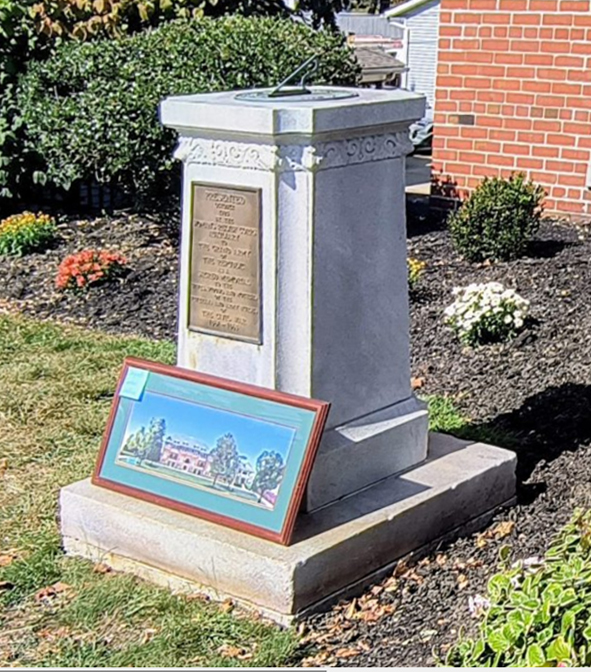 On October 4, 2025 Madison Historical Society of Ohio was able to have their sundial returned after 32 years, when in 1993 it was moved to the lawn of Lake County Courthouse to reduce the chance of vandalism. The sundial was originally placed at Madison Home 100 years ago on Saturday, October 24, 1925 during a conference of the Women's Relief Society. From 1904 to 1962 the state ran this building as it was run since 1889, for the needy widows, mothers and children of Ohio’s veterans. They named this building the Madison Home.
Cheryl Swackhammer, president of the Madison Historical Society, opened the rededication ceremony and thanked everyone who had made the sundial's move back to Madison possible. The return of the dial was spearheaded by Kenneth Gauntner, a former Madison Township trustee's and Lake County administrator.
The circular bronze dial with open gnomon sits on a tapered pedestal 3ft (1m) high with a bonze plaque on the pedestal recording the dedication for the Women Relief Society 100 years ago.
Read the article by gmcvey in the Gazette On-Line News at https://gazettenews.com/sundial-monument-rededicated-at-madison-historical-society/
- Details
- Hits: 503
Prosciutto di Portici Sundial's Owner
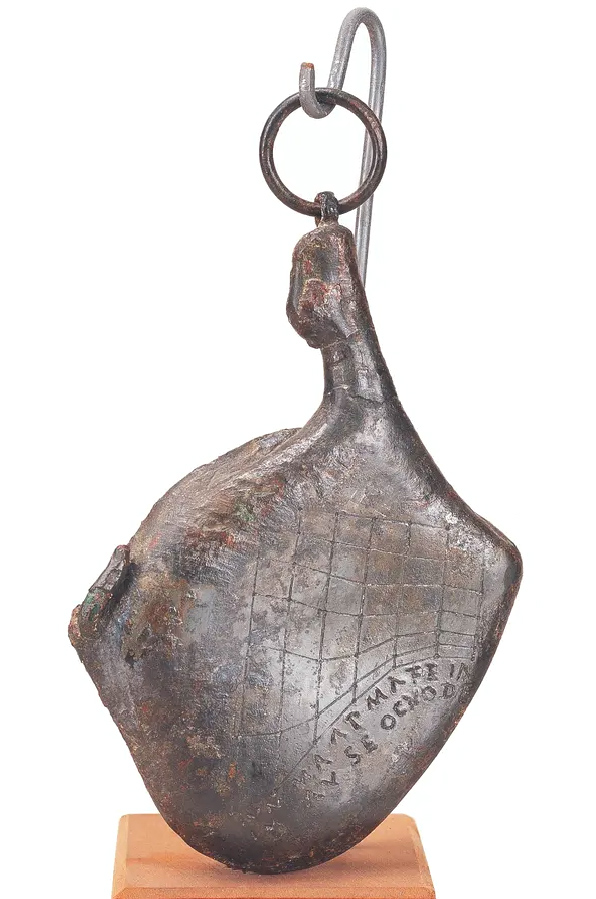 Prosciutto di Portici (Ham) Sundial Photo: Getty ImagesThe Prosciutto di Portici Sundial, more often called the Portici Ham Sundial, dates from the first century somewhere between 8 BCE to 79 CE. This small silvered bronze dial was uncovered on 11 June, 1755 in the ruins of Herculaneum (current day Portici) in the "Villa of the Papyri", buried in volcanic ash and charred papyri from the eruption of Mount Vesuvius in 79 CE. The form of the sundial, which resembles a ham, has been extensively studied. It is an altitude dial with similarities to the cylindrical sundial.
Live Science reporter Kristina Killgrove writes, "Historians have long assumed that the owner of the Villa of the Papyri was L. Calpurnius Piso Caesoninus, the father-in-law of Julius Caesar." https://www.livescience.com/archaeology/romans/prosciutto-di-portici-a-portable-sundial-that-looks-like-a-pork-leg-and-it-was-likely-owned-by-julius-caesars-father-in-law-before-mount-vesuvius-erupted
Calpurnius likely commissioned the Epicurean philospher Philodemus to drave the numerous charred scrolls at Villa of the Papyri. Killgrove commented that "This may explain why the Roman pocketwatch was shaped like a ham. For adherents of Epicurean thought, the lowly pig was often used as a metaphor, as it was seen as a naturally pleasure-seeking creature.
To clarify the use of the dial and the drawn lines attributed in the article as "hours before or after sunset" were actually temporal hours. The lines measuried the hours from sunrise to sunset. Temporary (ancient) hours go across the dial face and vertical lines represent the boundary between the zodiac signs representing the twelve months of the year. In this dial the twelve months have been “folded” and the month pair labeled between the lines: IUN-IU (June-July), MA-AU (May-August), AP-SE (April-September), MA-OC (March-October), FE-NO (February-November) and JA-DE (January-December). Notice that both July and August are used and the longest shadows occuring at the end of June while the shortest occur at the end of December. Further, since July and August are named, the dial was created after the reign of Julius and Augustus Caesar, and in particular when Augustus renamed the month Sextilis to August in 8 BCE.
The Ham dial has a fixed gnomon, the flattened piece at middle-left in the photo. When properly working, the gnomon is actually much longer and the tip set a specific distance above the dial face and at the upper left corner of the hour-date lines. To read the time, the dial is rotated from a string at top of the dial until the shadow falls on the vertical date line (or distance between) corresponding to the date. Like the cylindrical sundial, time is read from the downward shadow of the tip crossing the temporary hour line.
The Ham dial also has “folded” hour lines that run across the dial to tell temporary (ancient) hours. The lines are from top to bottom are for sunrise, 1st/11th, 2nd/10th, 3rd/9th, 4th/8th, 5th/7th, and at bottom, the 6th hour line for mid-day.
- Details
- Hits: 2197
Rare Astrolabe Discovered by Chance in Verona Museum
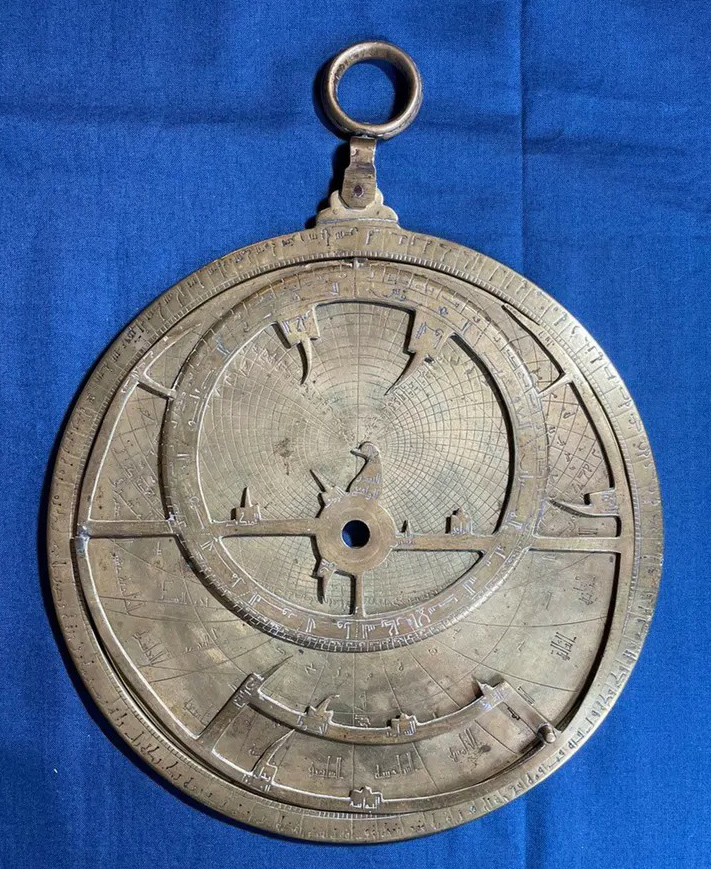 Photo from phys.org/news Federica Gigante, "A Medieval Islamic Astrolabe with Hebrerw Inscriptions in Verona," Nuncius, Vol 39, Issue 1, 1 March 2024Dr. Federica Gigante, from Cambridge Univerity's History Faculty, discovered a rare astrolabe sequestered in a museum at Verona, Italy. Publishing in Nuncius (1 March 2024) Dr. Gigante presents "a hitherto unknown remarkable astrolabe from Al-Andalus which likely belonged to the collection of Ludovico Moscardo (1611–1681) assembled in Verona in the seventeenth century. The astrolabe is datable to the eleventh century and features added Hebrew and Latin inscriptions. It underwent many modifications, additions, and adaptations as it changed hands and owners over time thus becoming a palimpsest object. With its added translations from Arabic into Hebrew, the astrolabe closely recalls the recommendations prescribed by the Spanish Jewish polymath Abraham Ibn Ezra (1089–1167) in the earliest surviving treatise on the astrolabe in the Hebrew language written in 1146 precisely in Verona." Today the astrolabe is preserved at the Fondazione Museo Miniscalchi-Erizzo.
"This isn't just an incredibly rare object. It's a powerful record of scientific exchange between Arabs, Jews, and Christians over hundreds of years," said Dr. Gigante.
- Details
- Hits: 5150
Smithsonian Photo Contest - Jaipur Sundial
Smithsonian Magazine holds a photo-of-the-day contest. Winner on 30 Oct 2023 was Harita Sistu who took a photo of the large sundial of Jantar Mantar, Jaipur India (taken in July 2022). Harita notes: "I wanted to try my best to capture just how massive the instrument is and bring focus into the incredible skill that went into designing and constructing it."
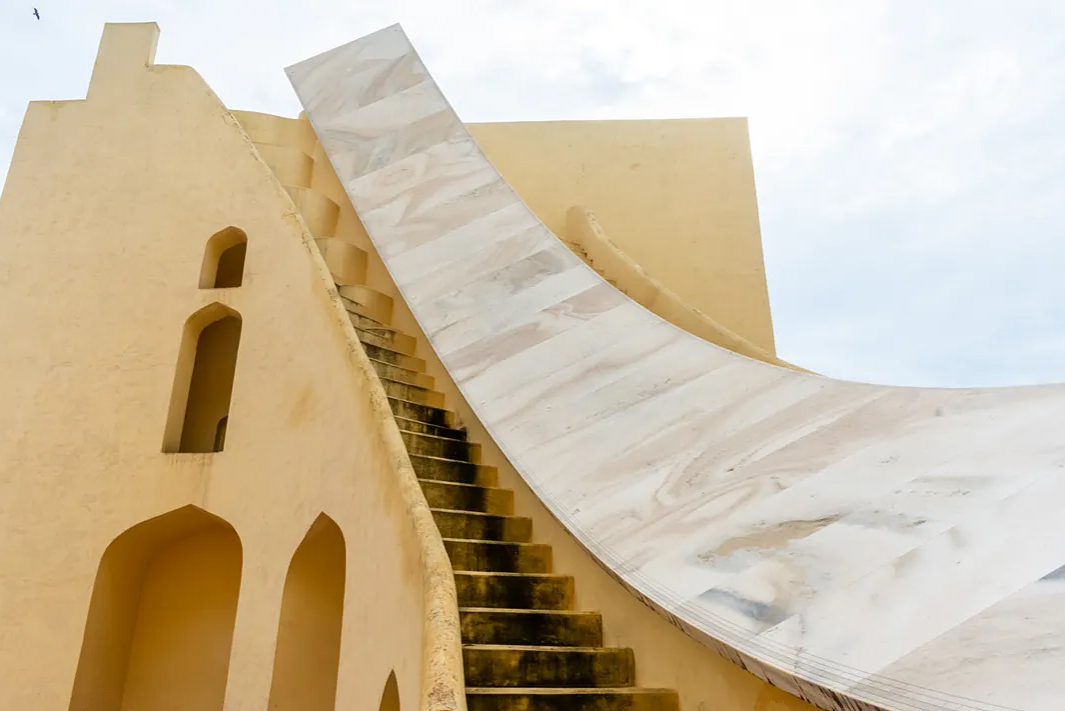 Harita Sistu - Award winning photo of the Equatorial Sundial at Jaipur, India
- Details
- Hits: 5519
Indiana French Dial Found
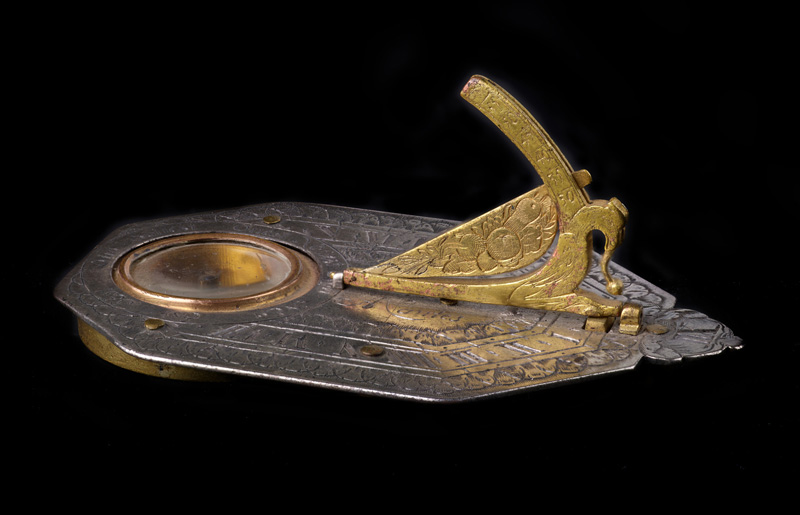 Smithsonian Collection - Pocket sundial by Bourgaud of Nantes, 1660–1675. (MA.325565)From the National Museum of American History is an article about "How did a French pocket sundial end up buried in a field in Indiana?" published 20 July 2022 by Kidwell & Schechner.
It started in 1860 when Dr. Elisha Cannon, while plowing a field in Indiana, came across a strange object. It was a French Butterfield sundial. It ended up in the Smithsonian collection 100 years later, where it quietly sat until recently when curator Peggy Kidwell wanted to learn more. She contacted Dr. Sara Schechner, David P. Wheatland Curator of the Collection of Historical Scientific Instruments at Harvard University, to join the investigation.
The dial is inscribed "Bourgaud Nantes" showing it was from the workshop of a clockmaker in Nantes, France. As with all Butterfield dials it contained a magnetic compass with declination corrections for orienting the dial to north and a miniature plumb bob to hold the dial level. The gnomon support is in the traditional shape of a bird allowing the gnomon itself to be adjusted to a range of latitudes. Look closely at the chapter ring of hour marks in Roman numerals. Outside the numerals is one hour line scale and on the inside of the numerals is a second scale. The user could approximate the time between these two scales, done for the extreme latitudes 30 and 55 degrees.
"In her research on sundials in the American colonies, Schechner has drawn attention to several of these dials, and notes that some 18th-century French sundial makers, like Pierre le Maire (and his son of the same name), made pocket dials that carefully listed the latitude of places of French interest in both North and South America." How did the dial end up in Indiana? It could have been carried there by Dr. Cannon and his wife Gulielma, Quakers who in 1840 left North Carolina, finding that "living in a state where African Americans were legally enslaved was intorable." Or the dial may have been left a century earlier when the French occupied much of what is now Indiana, leaving outposts such as Terre Haute and possibly a lost sundial.
Read the article: https://americanhistory.si.edu/blog/pocket-sundial
- Details
- Hits: 7066
- Hudson Valley's Missing Sundial
- Virtual Tour of Jantar Mantar Solar Observatory
- Harvard Collection of Diptych Sundials
- Mystery of 1733 Sundial
- World's Oldest Mariner's Astrolabe
- Armenian Sundials - Necessity Becomes History
- Frederick Douglass Sundial
- Barnwell Sundial Stands Test of Time
- Bobby Jones Sundial - Slow Time
- Gnomonic Tales of Our Founding Fathers
- Historic Ingleside Sundial
- Auction of Rare Foster Manuscript
- Founding Fathers
- Antique Sundial Treasures
- Building Gone - Dial Lives On
- Historic Replica Dial for Holland College
- Ivory Diptych Sundial Unearthed at Jamestown
- Dial 'Down Under' Acquired by Historical Museum
- Hour Horary Quadrant
- Washington's Sundial in the Spotlight