
al-Shatir Sundial Technology Challenge of 1371
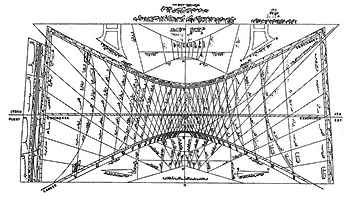 At 3pm on August 15th Roger Bailey of the North American Sundial Society will hold a public lecture on the historic Ibn al-Shatir sundial at the Great Falls Library in VA. The Analemma Society proposes to recreate the dial’s design, adapted for the latitude of Observatory Park, The Turner Farm, in Great Falls, VA.
Hopefully this will be the second major dial at Observatory Park maintained by the Analemma Society in conjunction with the Fairfax County Park Authority. The first dial was a commemorative dial designed and built by Tony Moss for the 400th anniversary of Jamestown, VA.
“High on the minaret of the Great Mosque in Damascus is a remarkable sundial created by Ibn al-Shatir in 1371. Through the 10th to 14th centuries the science of astronomy, timekeeping and sundials had advanced in major Moslem centres like Cairo and Damascus. Based on the developing science of timekeeping, Ibn al-Shatir designed a unique instrument that was a breakthrough…The sundial features equal hours rather than the previous system of dividing the day into 12 hours regardless of the seasonal changes.”
Three different time systems are drawn on the dial, reading time from sunrise, sunset and noon. “The dial has reference lines for all five Moslem prayer times, even those at daybreak and nightfall when the sun was well below the horizon. This sundial was the first to use a polar gnomon, parallel to the earth’s axis and pointed north… The dial represents technological changes anticipating the design of sundials created later in the Islamic Middle East and Christian Europe….”
UPDATE: "We are very much looking forward to Roger's talk next Wednesday and hope that many in the Great Falls community and nearby can attend. Faculty and students from the George Mason Ali Vural Ak Center for Global Islamic Studies and the Georgetown University Islamic Studies Department have stated interest in attending."
"Presentations about the Ibn al-Shatir Sundial are not new to the Great Falls area. In August 2006 an exhibit about the sundial that was prepared by Charles Olin and a friend of the Analemma Society, Barbara Smith, was displayed at the Great Falls Library. In September 2006, the exhibit was moved to the McLean Community Center. It is splendid that Roger is able to stop here on his way to the North American Sundial Society meeting in Ashville. We look forward to greeting him."
Charles and Jacque Olin of the Analemma Society
[Material cited is, in part, from a bulletin published by Jeff Kretsch of the Analemma Society and email from The Analemma Society. To become a member, go to www.analemma.org.]
- Details
- Hits: 19134
Gardom's Edge Monolith
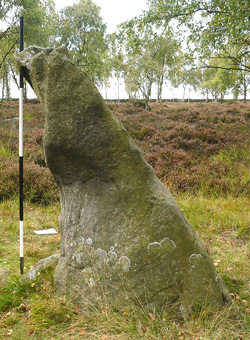 Gardom Edge Monolith [photo courtesy of Dan Brown, Nottingham Trent University]A two meter standing stone at Gardom’s Edge may be an astronomically aligned monolith set up during the Neolithic period 2,500 – 1,500 BCE to recognize the summer solstice. According to Dan Brown, Andy Alder and Elizabeth Bemand of Nottingham Trent University, “Such an astronomically aligned stone could be described as a seasonal sundial … However it is not intending to mark local time during a day or measure exact dates during a year. Rather the seasonal shadow casting allows for the display of cosmological knowledge such as the ‘death’ and ‘rebirth’ of the Sun”…
The upward facing north slope of the stone remains in shadow until near the time of Summer solstice. Today the stone points south at an upward tilt of 58.3° +/- 2.9°, seemingly aimed at the highest rise of the summer sun, computed for the Gardom Edge latitude of 53.26° as 60.7° in Neolithic times.
Was this a single day’s observance? The researchers have carried out 3-D computer modeling of sunlight on the upper edge of the stone through the seasons, adapting for changes in the Earth’s ecliptic plane back four millennia. As they calculate, depending upon the angle of the stone, not only could it be completely illuminated at solstice, the top edge could have been in light for several hours before and after solstice.
The researchers conclude, “Given its uniqueness as one of the few single standing stones in this region, this idea [of astronomical alignment] cannot be confirmed through comparison with other sites close by. This fact makes it challenging to rule out chance alignment of the stone that could seem to create a seasonal sundial.”
Nevertheless, the presence of packing stones at the base of the monolith indicate intentional stone alignment. “Other examples of shadow casting in the British Isles have also demonstrated that the skills were present at this time including the symbolic importance.”
- Details
- Hits: 15543
Pantheon Sundial Shine Light on Emperor
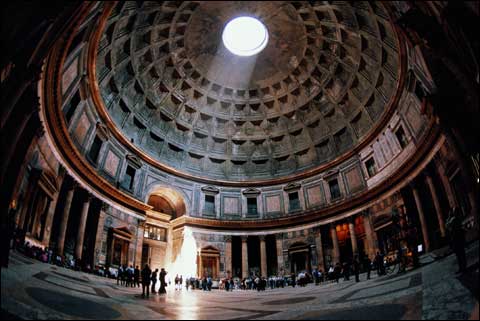
One of the most iconic buildings in the world, the Pantheon in Rome is an enduring testament to the power and glory of ancient Rome. At the same time, it has also always posed something of a mystery. The only source of natural lighting is a thirty-foot diameter hole at the very top of the hemispherical dome, often referred to as the "oculus".
Working since 2009, scholars Guilio Magli and Robert Hannah discovered that at midday on the equinoxes, a shaft of circular light shines through the oculus and illuminates the Pantheon's entrance.
As it turns out, the size and shape of the beam almost exactly matches a semi-circular stone arch set above the doorway. Its been suggested that the positioning of the beam of light would have had significant ceremonial significance if the arrival of the Roman emperor was timed to coincide with the times of favorable alignment. This discovery adds yet another example of technical prowess to the long list of engineering achievements which have long been regarded as a hallmark of the Roman era.
[Note: For other building alignments check out Meridiana-Solar Lines in the Church here on our NASS website links]
Article Source: http://www.telegraph.co.uk/news/worldnews/europe/italy/8673508/Romes-Pantheon-may-have-been-built-as-a-massive-sundial-researchers-reveal.html
- Details
- Hits: 25246
Early Astronomers
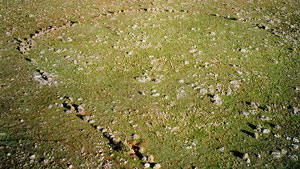 photo credit: Andrew Caswell and Robert Cockburn of The Daily TelegraphAsk a person what is the earliest evidence of humans building structures to mark significant celestial events, and one offer "Stonehenge". But there may be a structure built thousands of years early according to some experts in Australia.
A site "down under", name Wurdi Youang, estimated to be older than 10,000 years, has a strange arrangement of stones with alignments toward solstices and equinox that has been scrutinized by several eminent Australian scientists. They conclude that the placement and alignment of the stones is not an accident and there is a perfect alignment with the setting sun on the mid-summer day. Understandably, the exact location of the site is a well-guarded secret, but it is known to be west of Melbourne approximately 80 kilometers.
- Details
- Hits: 15427