
New Insights into Ancient Sundials
Larisa N. Vodolazhskaya of the Department of Space Physics at Southern Federal University (SFU), Rostov, has brought two ancient time keepers together with a new and startling result. The story starts at the turn of the end of the 19th century with the discovery of an L-shaped bar found in the tomb of Thutmose III (1479-1425 BCE). that appeared to be a sundial. In the 1930's a "user manual" of sort was found carved on the tomb ceiling of Seti I (1290-1279 BCE) at Abydos. The ideal L-shaped bar had lines engraved with distances from a starting mark of 3, 6, 9, and 12 units. The Seti I text describes these spacings as "an established procedure". But what is the procedure?
Then in March 2013 during the excavation of rubble associated with worker huts of Ramesses II (1279-1213) in the Valley of the Kings, Professor Dr. Susanne Bickel and her student archeological team from the University of Basel found one of the oldest sundials in the world. It is a vertical dial of limestone with what appear to be crudely drawn hour lines. The Basel team found a poor fit using hour lines with15o spacing expected of a traditional “unequal hour” sundial with horizontal gnomon.
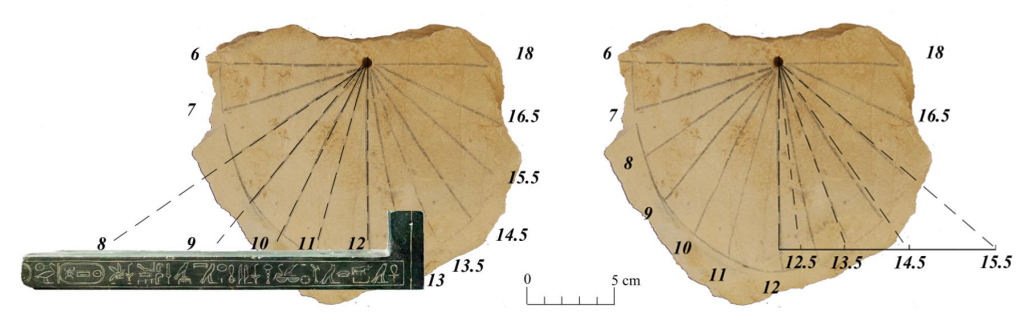 Dr. Vodolazhskaya of Department of Space Physics at Southern Federal University (SFU), Rostov, shows relation between tradition L-shaped Egyptian solar indicators and Egyptian vertical dial discovered in the Valley of the Kings by the University of Basel in March 2013Dr. Vodolazhskaya analyzes the use of these two sundial objects together, showing that the Valley of the King dial has accurately drawn hour lines that can be constructed by the L-shaped bar. The simple spacing distances of marks on the bar (ideally 1, 3, 6, 9 and 12) are measured for two L-shaped solar indicators held in the Berlin Museum. The ratios are close to ideal, but not exact. Vodolazhskaya argues that these differences of L-shaped solar markings are intentional: one for marking (or interpreting) the morning hours of a vertical dial, and another for marking the afternoon hours where the lines are offset by half an hour. Vodolazhskaya speculates,"we associate the half-hour shift in the markup with the need for ...midday rest for workers - the traditional siesta ..."
Dr Vodolazhskaya shows that Egyptian time telling was far more advanced than previously credited, but done in such a way that only the cognoscenti, the priesthood who held the L-shaped bar, could draw the lines of a sundial to create sundials with astounding accuracy of time. Her analysis is significant, showing that the Valley of the King dial using "equal hours" implies a gnomon pointed to the north celestial pole. This Egyptian feat would not be replicated again for nearly 3000 years until the Arab Ibn al Shatir constructed the first "modern" sundial at the Great Mosque in Damascus in 1371 CE.
Read more: http://arxiv.org/ftp/arxiv/papers/1408/1408.0987.pdf
- Details
- Hits: 17927
al-Biruni's Cosmos
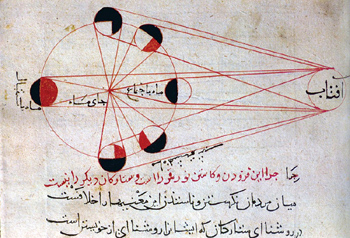 Al-Biruni's diagram of the moon's phases. Credit: photo reproduction from Seyyed Hossein Nasr, Islamic Social Science: An Illustrated Study (World of Islam Festival Publishing Co., 1976) Photo use for non-profit educational purposes only.Ibn al-Shatir, whom we give credit for inventing the first modern sundial with gnomon pointing to the celestial pole in 1371 C.E., is but one of many scientific scholars of Central Asia during the “Eastern Renaissance” that lasted from about 800 to 1500 C.E. In this week’s issue of Science, [20 June 2014] Richard Stone reviews the accomplishments of Abu Rayhan al-Biruni (born 973 C.E.) and the possibility that he "discovered" the American continent.
Situated at the crossroads of cultures from China, India, the Middle East, and Europe, al-Biruni was an acomplished astronomer at an early age. At 16 he measured the height of the midday sun and calculated the latitude of his hometown, now in present day Khiva, Uzbekistan.
The Science article reviews work by S. Frederick Starr, chair of the Central-Asia-Caucasus Institute of Johns Hopkins School of Advanced International Studies: “[al-Biruni] traveled widely as an adult, and at a hilltop fortress near present-day Islamabad he devised a technique for measuring Earth's circumference using an astrolabe, spherical trigonometry, and the law of sines. (Like the ancient Greeks, Biruni was aware that Earth is round.) His calculation was a mere 16.8 kilometers off the modern value…”
“In a massive tome called the Masudic Canon completed in 1037 C.E., Biruni analyzed classical Greek, Indian, and Islamic astronomy and used ‘bold hypothesizing’ to sort out credible claims from fantasy, Starr says.” …. “Most sensational of all may be Biruni's ‘discovery’ of America. For the purpose of precisely determining the qiblah—the direction of Mecca during Islamic prayers—Biruni meticulously recorded coordinates of the places he visited, and compiled data on thousands of other Eurasian settlements from other sources. After plotting out the known world—possibly on a 5-meter-tall globe he is said to have constructed—he found that three-fifths of Earth's surface was unaccounted for … [al-Biruni] concluded that one or more landmasses must lie between Europe and Asia, writing, ‘There is nothing to prohibit the existence of inhabited lands.’”
- Details
- Hits: 13721
13th Century BCE Ancient Egyptian Sundial Discovered
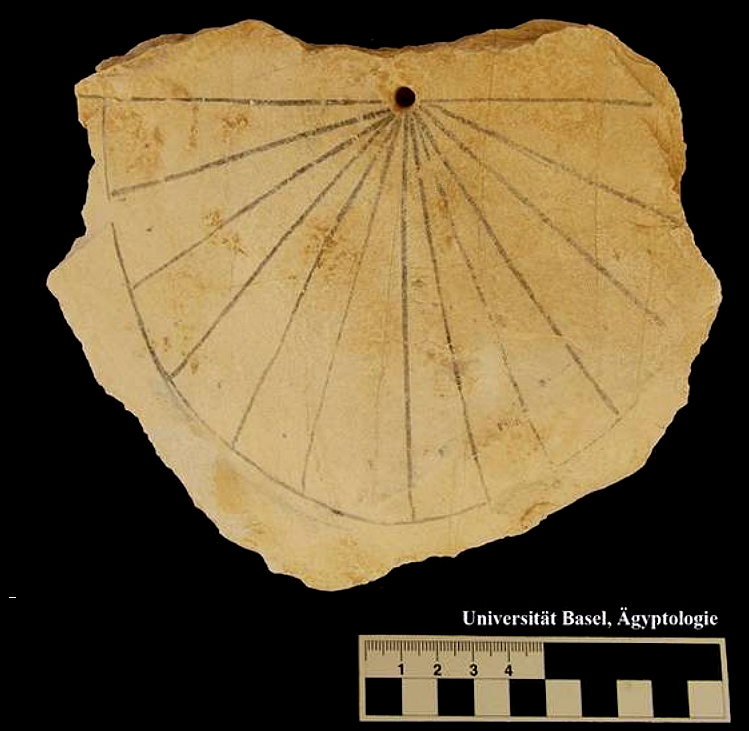 13th Century BCE Sundial [photo Courtesy University of Basel]Professor Dr. Susanne Bickel and her archeological team from the University of Basel found one of the oldest sundials in the world during this year’s excavation in the Valley of the Kings. A limestone sundial was found near tomb KV61 during a survey of the surface rubble. The location of the dial corresponds to an area where there are remains of workmen’s huts dating to the Ramesside Period of the 13th century BCE.
The dial was most likely a vertical, south facing sundial. The horizon line of the dial is about 16 cm across with a hole at the mid point to hold a simple horizontal metal rod or wood stick gnomon, indicating that the gnomon displayed shadows of temporal (seasonally uneven) hours. The limestone dial has a black painted semicircle. On each side of the vertical noon line are 6 segments of about 15 degrees each, representing morning and afternoon temporal (seasonally uneven) hours. Small dots in the middle of each hourly segment serve for even finer timing. Nevertheless, the hour lines are not drawn with precision.
The archeologists speculate that since the subdivision of the solar cycle in hours was a key aspect of depictions on the walls of the royal tombs where illustrated texts describe the nightly journey of the sun god through the underworld, the sundial could have supported the observations and visualization of this journey. Or the sundial could have been used as a simple clock by the workmen that toiled away digging and decorating the Ramesside tombs.
Read more at: University of Basel News Release 14 March, 2013
The details of the 2013 season excavation and survey for the University of Basel archeologists are found in their in Preliminary Report on the Work Carried Out During the Season 2013: Univ. Basel - Valley of the Kings Preliminary Report 2013
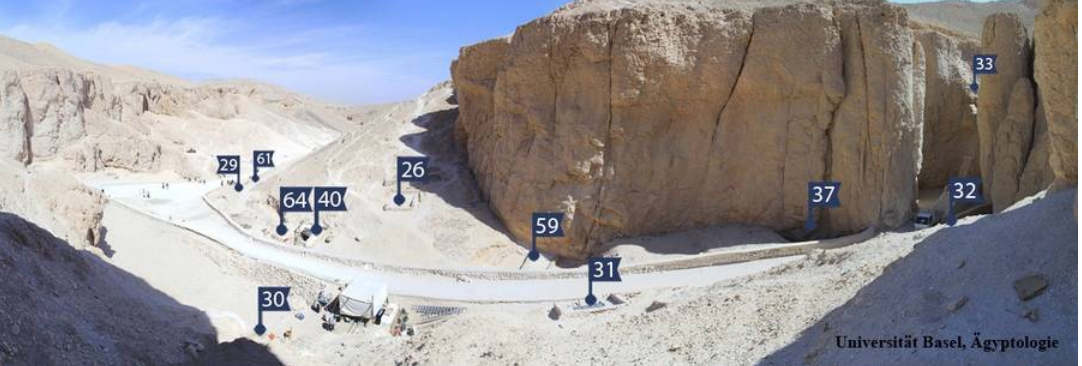 Valley of the Kings [photo Courtesy University of Basel]About 30m from KV64, a tomb of the 18th Dynasty, is KV 61 a single-room tomb that probably was never used. Near the site the limestone shard sundial was discovered. Here are extracts from the Preliminary Report:
“In preparation for the reopening and investigation of KV 61, part of the area above this tomb and in between KV 61 and KV 29 was cleared. On the east side of KV 61 the slope of the hill consists of a high heap of limestone debris, probably coming from the excavations of H. Carter and Th. Davis. This area must have been originally occupied by workmen’s huts in the Ramesside Period [so-called after the eleven kings who took the name Ramesses (1292-1069 BC)]. The back wall of a hut, which was partly discovered already in 2012, was found in this season. On the hill slope behind the hut were a few remains of wooden fragments with hieroglyphic inscriptions mentioning the name of king Amenhotep III."
“Some pottery originating from the huts as well as shards belonging to some funerary equipment were found in the area East of the hut and to the North of KV 29. Several limestone fragments of ostraca were found under a clean layer of sand and limestone chips inside the hut but also behind its wall in the East. A particularly interesting piece is an ancient sundial, which appears to be one of the oldest of its kind.”
"The remains of the huts will be included to the topographical map in the coming season. Further huts have probably been removed during the discovery of KV 61 in 1910 by E. H. Jones, who was working for Th. Davis. Today some big stones, similar to the discovered walls, are visible in the modern debris above KV 61. Our clearing of the area between KV 29 and KV 61 is done in order to secure the tombs and to prepare the entrance of KV 61 for an iron door in the coming season."
"We would like to express our sincere thanks to the Minister of State for Antiquities Dr. Mohamed Ibrahim and the Secretary General Adel Abd el-Satar, to the Director of Foreign Missions Dr. Mohamed Ismail Khaled, to the General Director of the Antiquities of Egypt Dr. Mohamed el-Bialy, to the Director of Luxor Mr. Mansour Boreik and to the Inspectorate of Western Thebes and its General Director Dr. Mohamed Abd El-Aziz, to the Director of the Westbank Mr. Nour Abd El-Ghaffar, to the Director of the Valley of the Kings Mr. Aiman Mohamed Ibrahim and Inspector Mr. Mahmud Hosni, to the Director of the Carter museum magazine Yahya Abdel Aal and Inspector Said Mamduh for their helpful cooperation, assistance and advice during our working season."
For even more about the tombs in the Valley of the Kings, see American Univ in Cairo - Theban Mapping Project
- Details
- Hits: 23289
al-Shatir Sundial Technology Challenge of 1371
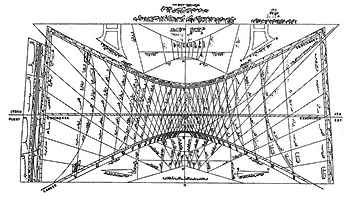 At 3pm on August 15th Roger Bailey of the North American Sundial Society will hold a public lecture on the historic Ibn al-Shatir sundial at the Great Falls Library in VA. The Analemma Society proposes to recreate the dial’s design, adapted for the latitude of Observatory Park, The Turner Farm, in Great Falls, VA.
Hopefully this will be the second major dial at Observatory Park maintained by the Analemma Society in conjunction with the Fairfax County Park Authority. The first dial was a commemorative dial designed and built by Tony Moss for the 400th anniversary of Jamestown, VA.
“High on the minaret of the Great Mosque in Damascus is a remarkable sundial created by Ibn al-Shatir in 1371. Through the 10th to 14th centuries the science of astronomy, timekeeping and sundials had advanced in major Moslem centres like Cairo and Damascus. Based on the developing science of timekeeping, Ibn al-Shatir designed a unique instrument that was a breakthrough…The sundial features equal hours rather than the previous system of dividing the day into 12 hours regardless of the seasonal changes.”
Three different time systems are drawn on the dial, reading time from sunrise, sunset and noon. “The dial has reference lines for all five Moslem prayer times, even those at daybreak and nightfall when the sun was well below the horizon. This sundial was the first to use a polar gnomon, parallel to the earth’s axis and pointed north… The dial represents technological changes anticipating the design of sundials created later in the Islamic Middle East and Christian Europe….”
UPDATE: "We are very much looking forward to Roger's talk next Wednesday and hope that many in the Great Falls community and nearby can attend. Faculty and students from the George Mason Ali Vural Ak Center for Global Islamic Studies and the Georgetown University Islamic Studies Department have stated interest in attending."
"Presentations about the Ibn al-Shatir Sundial are not new to the Great Falls area. In August 2006 an exhibit about the sundial that was prepared by Charles Olin and a friend of the Analemma Society, Barbara Smith, was displayed at the Great Falls Library. In September 2006, the exhibit was moved to the McLean Community Center. It is splendid that Roger is able to stop here on his way to the North American Sundial Society meeting in Ashville. We look forward to greeting him."
Charles and Jacque Olin of the Analemma Society
[Material cited is, in part, from a bulletin published by Jeff Kretsch of the Analemma Society and email from The Analemma Society. To become a member, go to www.analemma.org.]
- Details
- Hits: 19249
Gardom's Edge Monolith
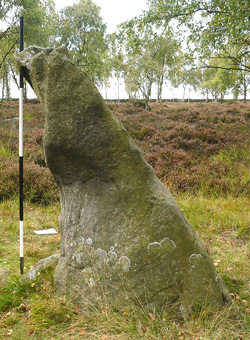 Gardom Edge Monolith [photo courtesy of Dan Brown, Nottingham Trent University]A two meter standing stone at Gardom’s Edge may be an astronomically aligned monolith set up during the Neolithic period 2,500 – 1,500 BCE to recognize the summer solstice. According to Dan Brown, Andy Alder and Elizabeth Bemand of Nottingham Trent University, “Such an astronomically aligned stone could be described as a seasonal sundial … However it is not intending to mark local time during a day or measure exact dates during a year. Rather the seasonal shadow casting allows for the display of cosmological knowledge such as the ‘death’ and ‘rebirth’ of the Sun”…
The upward facing north slope of the stone remains in shadow until near the time of Summer solstice. Today the stone points south at an upward tilt of 58.3° +/- 2.9°, seemingly aimed at the highest rise of the summer sun, computed for the Gardom Edge latitude of 53.26° as 60.7° in Neolithic times.
Was this a single day’s observance? The researchers have carried out 3-D computer modeling of sunlight on the upper edge of the stone through the seasons, adapting for changes in the Earth’s ecliptic plane back four millennia. As they calculate, depending upon the angle of the stone, not only could it be completely illuminated at solstice, the top edge could have been in light for several hours before and after solstice.
The researchers conclude, “Given its uniqueness as one of the few single standing stones in this region, this idea [of astronomical alignment] cannot be confirmed through comparison with other sites close by. This fact makes it challenging to rule out chance alignment of the stone that could seem to create a seasonal sundial.”
Nevertheless, the presence of packing stones at the base of the monolith indicate intentional stone alignment. “Other examples of shadow casting in the British Isles have also demonstrated that the skills were present at this time including the symbolic importance.”
- Details
- Hits: 15665
Pantheon Sundial Shine Light on Emperor
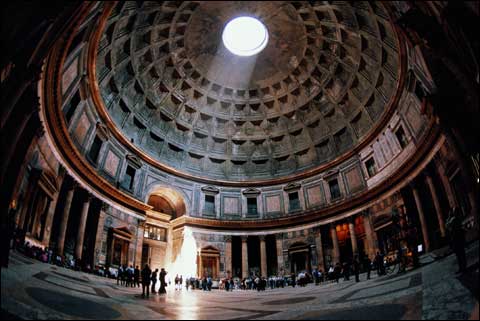
One of the most iconic buildings in the world, the Pantheon in Rome is an enduring testament to the power and glory of ancient Rome. At the same time, it has also always posed something of a mystery. The only source of natural lighting is a thirty-foot diameter hole at the very top of the hemispherical dome, often referred to as the "oculus".
Working since 2009, scholars Guilio Magli and Robert Hannah discovered that at midday on the equinoxes, a shaft of circular light shines through the oculus and illuminates the Pantheon's entrance.
As it turns out, the size and shape of the beam almost exactly matches a semi-circular stone arch set above the doorway. Its been suggested that the positioning of the beam of light would have had significant ceremonial significance if the arrival of the Roman emperor was timed to coincide with the times of favorable alignment. This discovery adds yet another example of technical prowess to the long list of engineering achievements which have long been regarded as a hallmark of the Roman era.
[Note: For other building alignments check out Meridiana-Solar Lines in the Church here on our NASS website links]
Article Source: http://www.telegraph.co.uk/news/worldnews/europe/italy/8673508/Romes-Pantheon-may-have-been-built-as-a-massive-sundial-researchers-reveal.html
- Details
- Hits: 25425