
Japan Sundial House
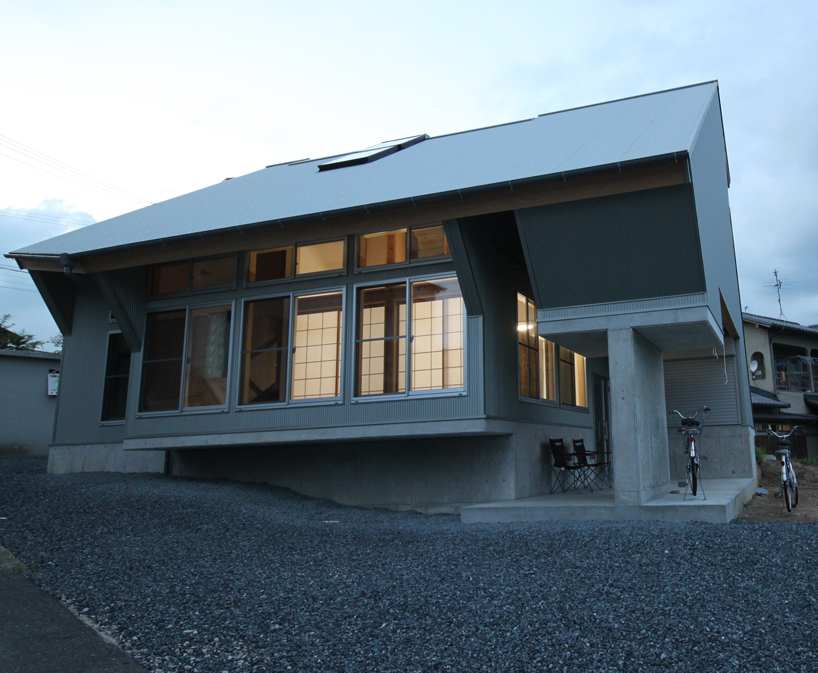 As reported in Design Bloom architect Kikuma Watanabe has designed a beautiful modern house integrating asundial and solar design principles: "The internal spaces support a comfortable environment where in summer it is naturally cool and in the winter it is warm. This ecological technology aids this passive system using the sun and the wind for an effective air conditioner."
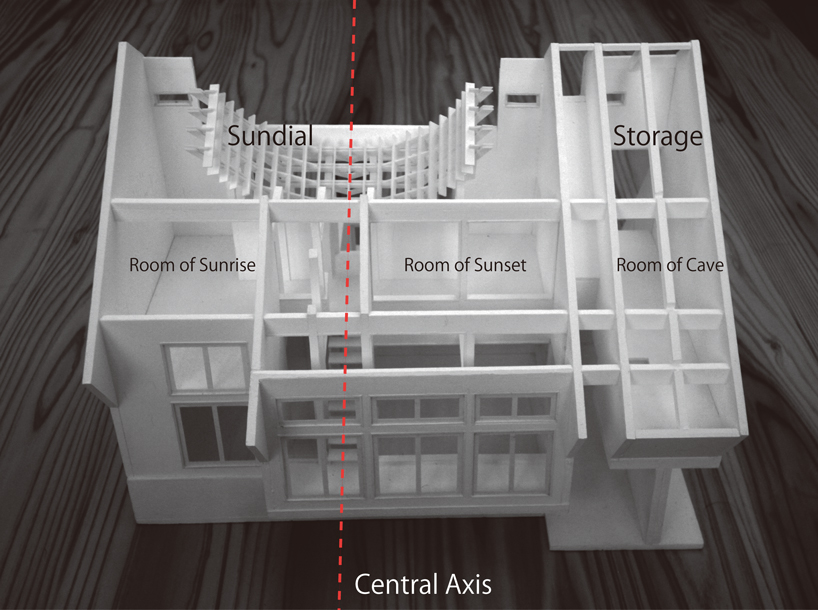
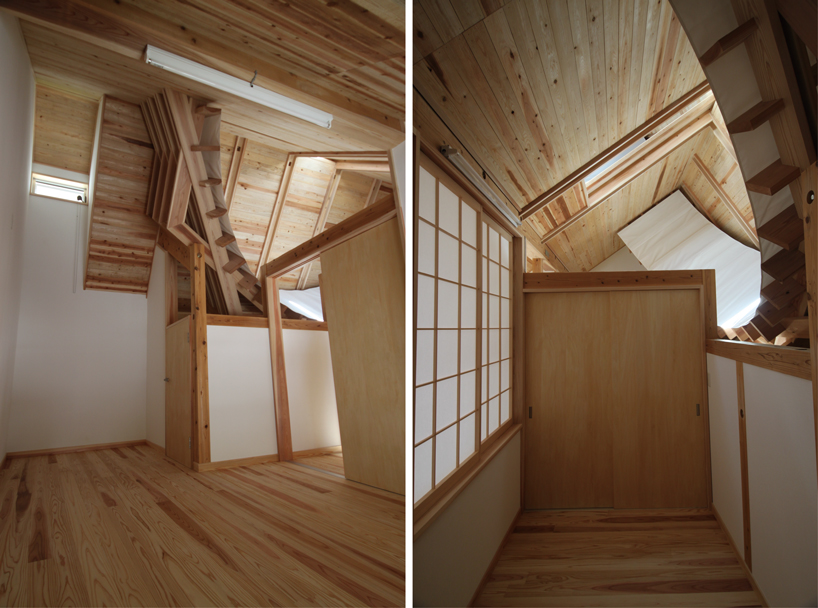
The interior of the house has two-story rooms and lots of natural wood. But unlike other houses except perhaps for the Cosmic Room in Corregadora, Mexico, it has a built in equatorial sundial. Central stairs lead up to the equatorial dial projection area with the gnomon itself a glass slit window in the roof. But the most important aspects for solar comfort are the angles of the eve overhangs, preventing hot summer sun from entering the windows yet allowing warming sunlight to enter during the winter . Brighter areas such as the kitchen are situated in rooms with southern exposure while the living room faces east looking out upon ponds and hills. Upstairs surrounding the equatorial dial projection ring are two rooms: the Room of Sunrise and the Room of Sunset, and on the main floor facing north is the Room of Shadow.
- Details
- Hits: 11529
Texas Christian University Gets New Dial
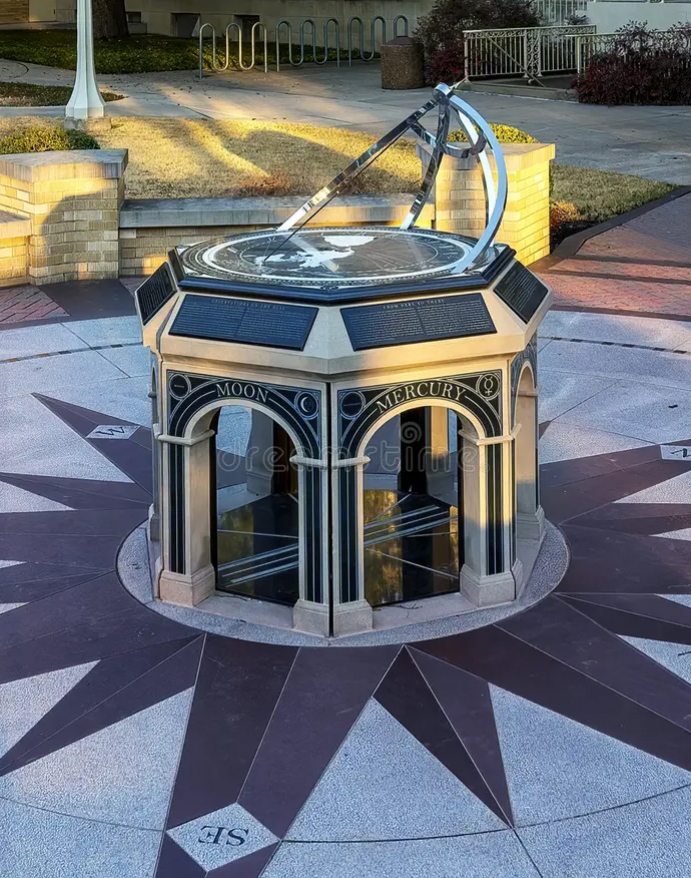 Texas Christian University (TCU) in Fort Worth Texas unveiled a new longitude sundial on May 5th, 2015. As William Andrewes, creator of the longitude dial explains, "The Longitude Dial" is based on an idea proposed in 1607 by Franz Ritter of Nuremburg...Ritter devised and published a world map projected from Nuremburg, with its lines of longitude arrayed to serve sundial as hour lines. However, the difficulties of creating a new project for each location and the expense of producing it in durable materials were considerable. Ritter's gnomonic projection map does not appear to have been developed for use in sundials - until now."
One of Andrewes sundials will be unveiled in front of Walsh Performing Arts Center, situated in the middle of a circular stone plaza. Andrewes monumental sundial prices start at $50,000. Read more at https://magazine.tcu.edu/latest-news/new-sundial-landmark-unveiled-on-campus/
As an interesting side note, the gnomonic project map upon which Andrewes creates his sundials was extensively used during World War II and into the 1950's by high frequency (HF) direction finding (DF) sites. On the gnomonic map not only are lines of longitude straight, but any great circle line of bearing is straight as well. Using a pin on the DF site, the lines of bearing could be drawn with an extended piece of string. Computer calculations eventually replaced the manual direction finding and geolocation method.
- Details
- Hits: 12003
World's Greatest Sundial?
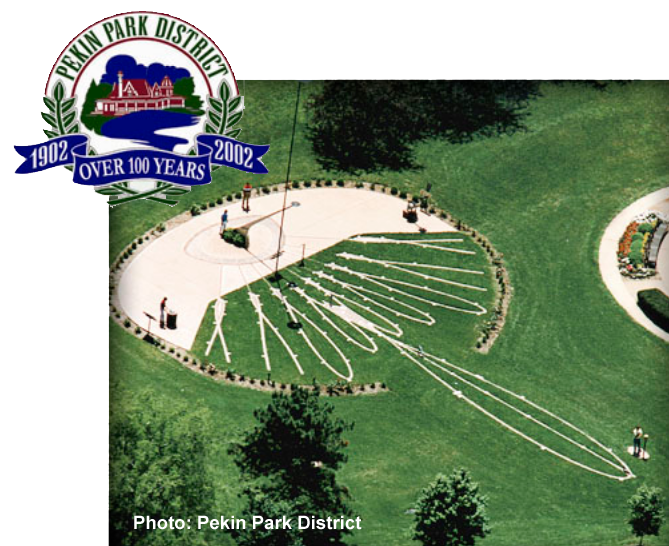 Of the 101 things that play in Peoria, the Pekin Illinois Sundial in Mineral Springs Park is listed #59, and billed as the World's greatest sundial in Pekin, Illinois. Even Google Maps marks the Pekin Sundial. The Pekin Park District says: "picturesquely located in the Sunken Gardens in Mineral Springs Park, this unique sundial tells the hours before or after noon and the highest point of the sun on a given day. More interesting information is available on the earth, sun, planets and latitude and longitude at the site."
The Peroria Journal Star interviewed Hentry Cakora, now 79, who built the dial using his family business, Tazewell Machine Parts and convinced the Pekin Park District to provide land for its construction in the Sunken Gardens of Mineral Springs Park. It's easy to spot on Google Maps just south of Court Street near the park's Lagoon that from spring through fall offers a pedalboat rides.
Cakora who knew about the sun's motion and was good at mathematics created a complex set of sundials. The main sundial is a horizontal dial about 6 feet tall of burnished steel, surrounded by hour marks on the ground. But if you're there near noontime there are extra treats. At the base of the sundial is a thin upright triangle split down the middle allowing it to cast a narrow beam of light toward the noon mark. Then there is a pole just north of the dial with two flat nodi about 12 inches in diameter, each having a hole in the center. The lower nodus casts a shadow that each hour falls on an analemma that allows correction for the sun's irregular "Equation of Time". Charts explain this to the observer as well. The upper nodus casts its shadow on a noon mark analemma, with small stakes to indicate the soltices and equinox.
Nearby is a planet. It is part of a planet trail that starts from the Park's nearby fountain.
Read more at: https://www.bordersundials.com/the-worlds-greatest-sundial-the-pekin-sundial-mineral-springs-park-illinois/
- Details
- Hits: 17370
2015 - IYL Words and Light
 A Letter to NASS regarding the IYL-2015 and the Literary Competition "Words and Light"
I would like to send you the direct link to more details on this competition, as I believe it may be of interest for some members of the NASS (I saw the Art and Literature section in the "Teachers Corner"). The deadline for submitting entries is coming soon - 31 March:
http://www.light2015.org/Home/About/Latest-News/February2015/IYL-Literary-Competition.html
“Words and Light” is a tribute to all the writers who were inspired by Light, writers who were interested in the Science of Light, and scientists who were also poets. The Competition is dedicated to Mikhail Vasilyevich Lomonosov and Johann Wolfgang von Goethe, celebrating the publication of the grammar book by Lomonosov written in 1755 which reformed the Russian literary language by combining Old Church Slavonic with the vernacular (160th anniversary in 2015), and to the book "Theory of Colours" (Zur Farbenlehre) by Goethe, published in 1810, which contains detailed descriptions of phenomena such as coloured shadows, refraction, and chromatic aberration (205th anniversary in 2015).
Yours sincerely,
Ana Luisa
--
Dr. Ana Luisa Simoes Gamboa
Associate Professor, Department of Industrial Ecology
ITMO University (Saint Petersburg National Research
University of Information Technologies, Mechanics and Optics
Saint Petersburg, Russia
+7 911 716 37 22
- Details
- Hits: 15824
2015 - International Year of Light
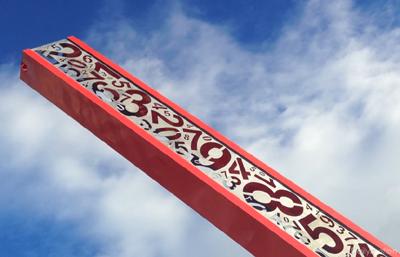 SOLART2 by artist MA2FUNESCO has declared 2015 the International Year of Light and Light-Based Technologies (IYL-2015). For sundialists, the inauguration of SOLART2 on the June 2015 solstice may be the highlight. SOLART2 is the largest IYL-2015 artistic sundial project in Europe. It is located in Rivesaltes at the northern entrance of Perpignan, France. It was initiated in 2013 as a strong symbol of sustainable development. Artist MA2F (Marc-Andre 2 Figuères) is constructing the sundial with an incredibly large gnomon created from a double metal bar with numbers silouhettes cut into the structure. The dial is meant to illustrate the flow of matter and energy, projecting a continually changing shadow of numbers onto the dial face during the progression of solar time. The edges of the gnomon are painted red "as a visual value and mastery of light". You can see a video of the dial at: http://ma2f.com/pages/solart2.php
The International Year of Light and Light-Based Technologies (IYL-2015) is a global initiative adopted by the United Nations to stress enhanced global awareness of and increased education in the science and technologies of light are vital for addressing challenges such as sustainable development, energy and community health, as well as for improving the quality of life in both developed and developing countries .... With UNESCO as lead agency, IYL-2015 programs not only promote light in the modern world, but celebrate milestone events in light and optics. Project videos can be seen at: http://www.light2015.org/Home/About/Resources/Videos.html
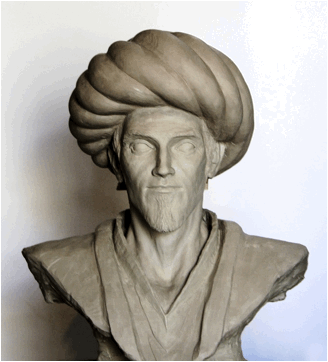 Bust of Ibn al-Haytham made by artist Ali Amro and commissioned by 1001 Inventions for the UNESCO IYL-2015Opening IYL-2015 Nobel laureates, international dignitaries, leading scientists and representatives from governments, industry and academia were part of the 2,000 guests at the UNESCO headquarters in Paris that witnessed the launch of a global campaign titled 1001 Inventions and the World of Ibn Al-Haytham. This celebrated the scientific achievements of the renowned 11th century scientist Ibn al-Haytham and his works in optics and light including:
- The Light of the Moon, The Light of the Stars,
- The Rainbow and the Halo,
- Spherical Burning Mirrors,
- Parabolic Burning Mirrors,
- The Shape of the Eclipse,
- The Formation of Shadows,
- Discourse on Light, as well as his masterpiece,
- Book of Optics.
He invented the dark chamber “Albeit Almuzlim” which has the Latin translation of “camera obscura”- the device that forms the basis of photography. For more about Ibn Al-Haytham and his 1001 Inventions, go to: http://www.1001inventions.com/ibnalhaytham
Read more at: http://www.light2015.org/Home/Event-Programme
- Details
- Hits: 19035
Amelia Peabody Sundial
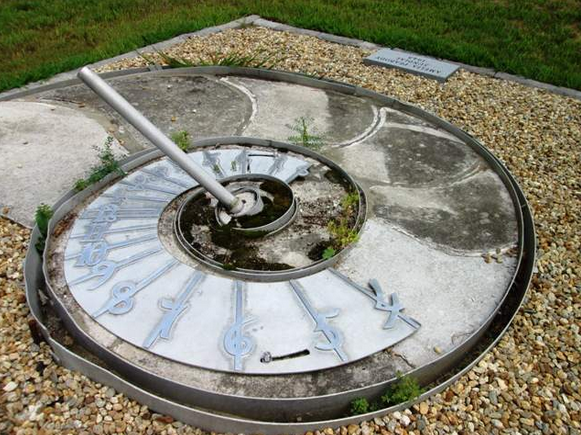 Amelia Peabody Sundial - Dover Town Library photo: Maureen Sullivan (Wicked Local Dover)Although Amelia Peabody died in 1984, her legacy and interest in sundials continues. In 1920 she moved to Dover, Delaware, and began raising thoroughbred horses. Ultimately she purchased more than 800 acres in Dover, becoming its largest land owner. She built three houses on her Powisset Farm, three other houses on other properties, and another called the Sun House at 145 Powisset St. in Dover.
As Eleanor Tedesco reports in the Wicked Local Dover on-line news, “The Sun House reflected her interest in heat generated by the power of the sun and was the first of its kind in New England. But the house failed to reach its goal of heating the building with the sun’s heat.” But true to its name, a graceful sundial in the shape of a Nautilus shell decorated her yard.
Eleanor Tedesco continues, “The present owners of 145 Powisset St. sought help from the Dover Historical Commission about restoring the house, but found that the house had to be demolished. They replaced the Sun House with an entirely new building. In the process the present owners offered Amelia’s sundial to the town of Dover. The Dover Historical Commission accepted their offer.”
“The restoration and relocation of the sundial was carried out by Boy Scout Paul Krusell, as his project to become an Eagle Scout. He was aided by Scouts Ben Barry, Daniel Berry, Charlie Friesen, Seth Novitch, Nick Novitch, Curt Pfannenstiehl and Harry Thomas; and non-Scouts Jake Heinlein and Harry Thomas....The sponsors of the project were the Dover Historical Commission and the Dover Parks and Recreation Department with Paul Tedesco, Dover town historian, serving as mentor.”
“Team Leader Paul Krusell and his team members organized the removal of the sundial from the town garage where the Dover Historical Commission [had it stored] to its new site on the grounds of the Dover Public Library … They also restored the sundial to its original form by following photographs and seeking outside professional help as needed. The boys landscaped the site and, by negotiating with the Natick Memorial Monument Company, installed a small granite marker honoring Amelia Peabody.”
Read more about Amelia Peabody's Sundial at http://dover.wickedlocal.com/article/20140913/
- Details
- Hits: 19642
- Westminster Dial with Analemma
- Renaissance Dial - It's Academic
- Four Minutes Til Sunset
- Bainbridge Island Equatorial Sundial
- Southwind Park to get 20-foot Tall Dial
- Carmichael's Monumental Sundial
- Wilkesboro Quilt Dial
- Sundials of Downton Abbey
- Granite Sundial at Penn State
- Heliodome
- Sundial Glass
- It Looks Like a Sundial - But Is It?
- 500 Foot Tall Gnomon Project
- The Garden Sundial - More Than Telling Time
- City of Bowie Announces Sundial Winner