
500 Foot Tall Gnomon Project
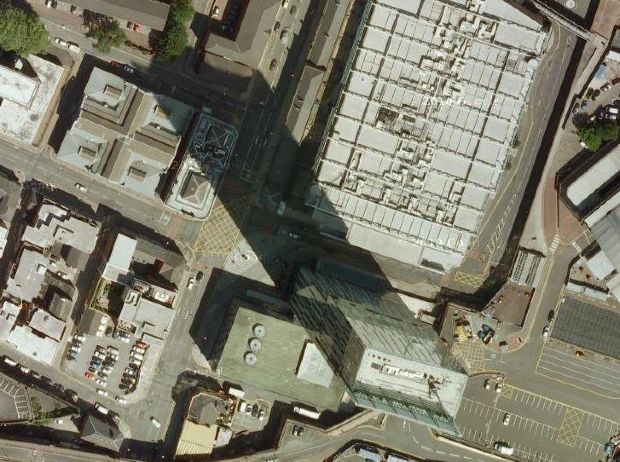 Photo From: Machester NewsWhile using Google Maps, some artists living in the UK became unusual dialists when it occurred to them that the shadow cast by a skyscraper could be used as the gnomon of a really tall sundial.
The forty-seven story Beetham Tower in Manchester is 554 feet tall and dominates the city's skyline. So it occurred to Annie Harrison, Jude Macpherson and Jacqueline Wylie to use the shadow cast by this structure to chart the progress of the sun as part of an art project.
From dawn to dusk on the summer solstice the group plans to patrol the city marking shadow locations and noting the time. On the hour they will be tweeting pictures and ecouraging local residents to get involved. In the event the weather doesn't cooperate, they have already mapped out where they believe the shadows will fall, so the project can move forward whether the sunshine is spotty or even non-existent.
Interested individuals can learn more about the Manchester Sun Dial project on Twitter at http://twitter.com/#!/mcrtimepiece In addition, they have also started a blog to talk about the project: http://manchestertimepiece.tumblr.com/
[Note from the NASS Webmaster: Although this is an interesting project, the shadow of a 554 ft tall building casts a very fuzzy shadow on the ground. The only point on the shadow that keeps time (using a gnomonic projection on the ground) is the tip of building shadow. So if the side of the building is used for trying to tell time, you can compute where the shadow will be each hour... but it will be valid only for one day, for which the Manchester group has chosen dawn to dusk on the summer solstice. Send us some pictures!! Use the dial submission feature on the Dial Registry tab.
- Details
- Hits: 12646
The Garden Sundial - More Than Telling Time
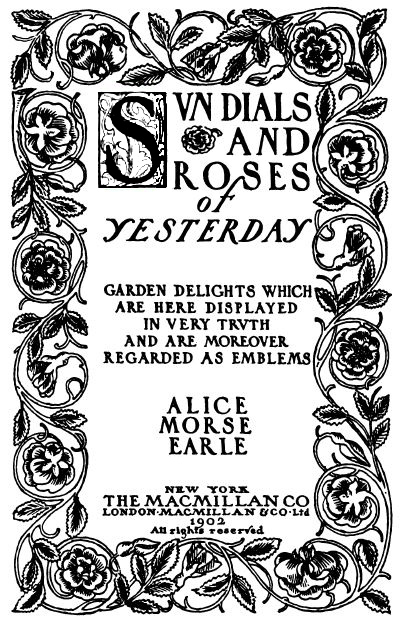 Sundials have always been part of gardens, as witnessed by Alice Morse Earle's book Sun Dials and Roses of Yesterday written 120 years ago. Her book title expanded on the cover with the subtitile "Garden Delights Which are Here Displayed in Very Truth and are Moreover Regarded as Emblems."
Thomas Christopher, a volunteer at the Berkshire Botanical Garden is author of a number of books on gardening and creates the Growing Greener podcast (thomaschristophergardens.com/podcast).
In a recent article for the Berkshire Eagle Thomas focused upon gardens and sunlight: Don't know where to put those light-sensitive plants? A sundial can help you figure out the light in your garden. https://www.berkshireeagle.com/arts_and_culture/home-garden/thomas-christopher-better-gardener-sundials/article_2822f5be-1d37-11ec-b39f-0fa8576b3736.html
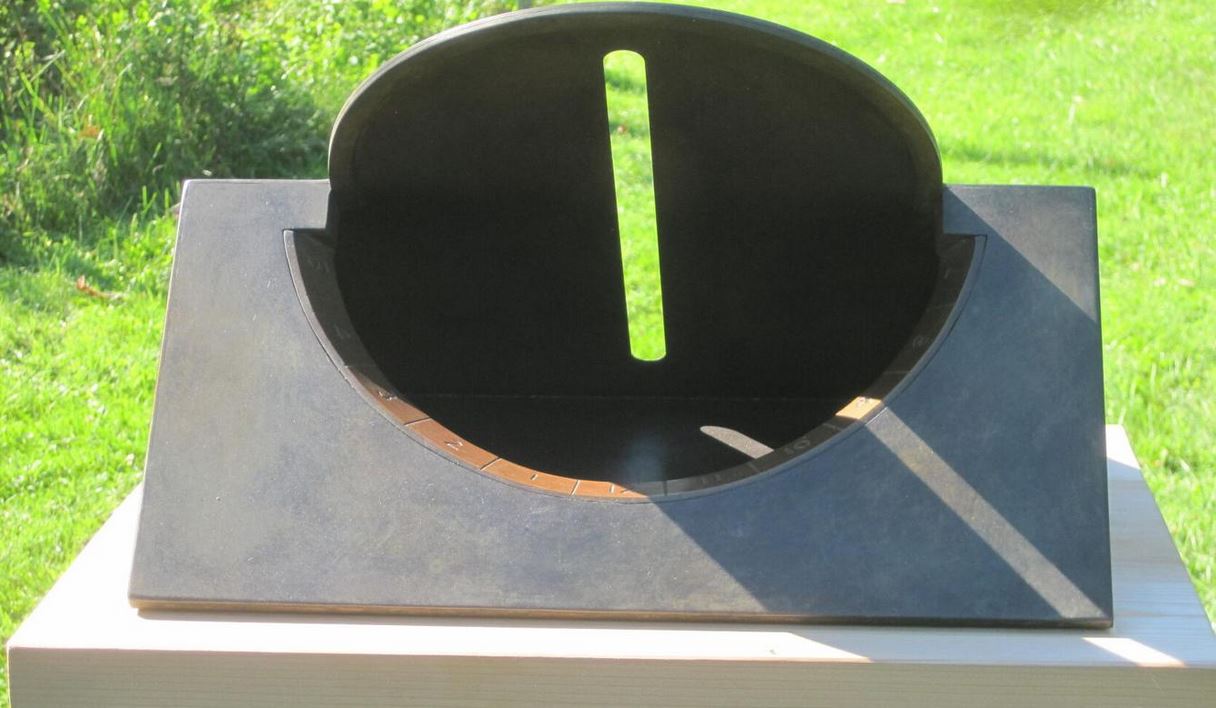
Christopher said, "There’s a lot of focus these days on solar energy, on harnessing the light from our nearest star to fuel our daily activities. Plants, of course, have been doing just that for millions of years. Sunlight, transformed by the green stuff in their leaves, is the energy that underlies almost all plant growth. Yet, though it is so fundamental to the garden, sunlight is very poorly understood by most gardeners."His interest in sunlight deepended when he met Robert Adzema, a sculptor, artist, and most important, a sundialist for onearly 50 years. Robert is a long time member of the North American Sundial Society and in 2004 Robert and Hal Brandmaier hosted the NASS annual conferance in Tenafly, NJ.
Christopher continued, "Robert is a sculptor who originally became interested in the varying nature of sunlight and its natural cycles because of the impact they have on the appearance of outdoor art. Robert soon moved from speculation to the study of a branch of sculpture that had, over millennia, subjected sunlight to a rigorous analysis. That is, sundials."
"With the encouragement of Robert’s sundials ... I’ve come to appreciate how the apparent motion of the sun across the vault of the sky changes with the seasons. I say “apparent” because of course it is we and the earth that actually move relative to the sun; the sun doesn’t cross the sky, it is just that the rotation of the earth makes it appear to do so. In the winter, the sun appears to ride low in the sky, rising through the spring to summer heights, and then sets again in the fall..."
 "Learning about the changes in the position of the sun relative to the earth has informed my gardening. Instructions for the placement of some light-sensitive plants, for example, recommend setting them where they will receive some early afternoon shade, shelter at the hottest part of the day. I know how to predict such a spot now, rather than merely rely on trial and error. And I know how to locate a spot for spring bulb plantings that will be penetrated by the sun early in the growing season when those plants need the solar fuel, even though it may be shaded later when the summer sun stands higher in the sky," and the bulbs are dormant.
"The greatest benefit of a sundial in the garden, according to Robert, is the connection it creates between the viewer and the place. Reading a sundial unites the reader with the placement of the garden on the earth and with the season as well as the time of day and the heavens. Sundials, we agreed, take their time, in every sense of the phrase."
- Details
- Hits: 8198
City of Bowie Announces Sundial Winner
 Gino and Judith Schiavone, members of the North American Sundial
 Society, are winners of the City of Bowie sundial contest to build and install a dial in front of the New City Hall under now construction. The value of the project is $90,000. Completion is expected in Oct 2010.
The City of Bowie City Council approved two works of art for their new City Hall. Artists Kate Kaman and Joel of Philadelphia were chosen to build a three-tiered kinetic sculpture that will be inside the City Hall. The team of Gino and Judith Schiavone from Taos, N.M. were chosen to build a 15-foot high sundial in front of the City Hall.
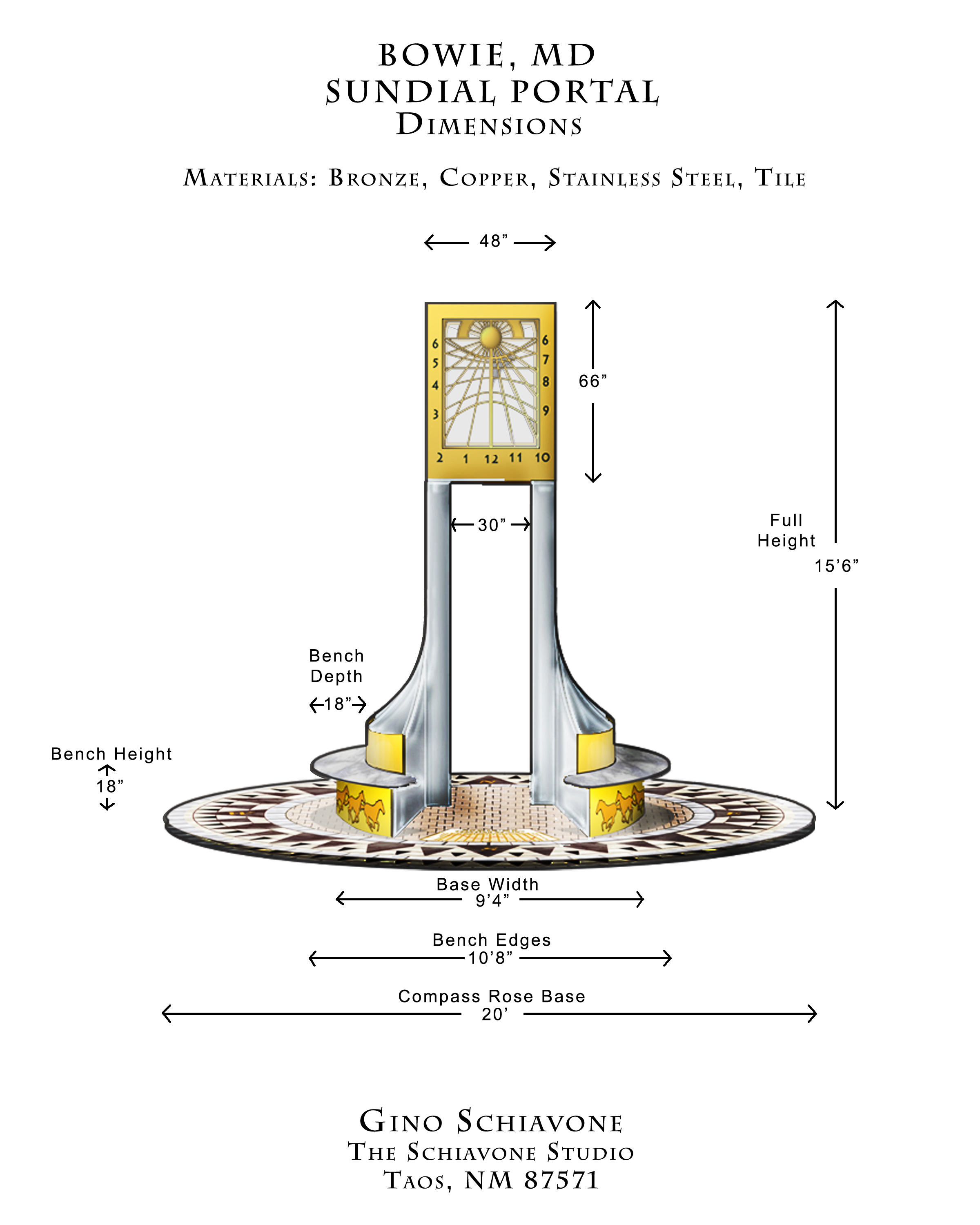 In this era of tight city budgets, much credit goes to the City of Bowie for setting aside funding for the arts. The interior kinetic sculpture contract is valued at $75,000 and the exterior sundial project will cost $90,000. The sundial completion date is expected to be October, 2010.
Gino and Judith Schiavone, members of the North American Sundial Society, designed a 4 ft by 6 ½ ft vertical bronze south declining sundial supported ten feet above the ground by two stainless steel pillars. At the base are two separated benches that along with the pillars form an inviting portal aligned with the City Hall’s glass portal with continuous view all the way to the lake behind the City Hall.
Beneath the benches is a metal fresco of running horses symbolizing the horse racing tradition of Bowie. Another subtle touch is a railroad “cowcatcher” support between the pillars and the dial recalling the City of Bowie’s railroad days.
The dial itself is a bronze grill of hour lines and declination lines for summer and winter solstice and the equinox. A unique feature of the dial plate is that it is translucent glass so that the time-telling shadows may be read either from the front of the City Hall (looking north) or by passing street traffic from the street (looking south). The motif of the dial is simple elegance, complementing the clock tower of the City Hall itself.
The dial is set in a 20 foot diameter plaza designed by Gino and Judith as an ornate compass rose. The cardinal points merge with the building architect’s large cardinal lines that extend throughout the front area of the City Hall.
- Details
- Hits: 9765