
Hour Horary Quadrant
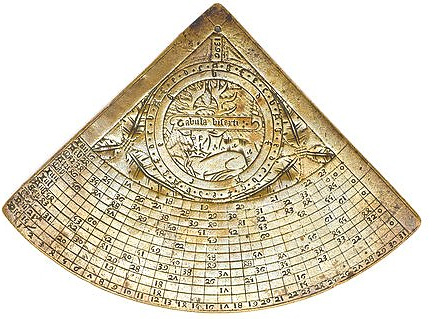 What’s worth more than £150,000? An hour horary quadrant dating to 1396 with the personal seal of Richard II. It is up for auction at Bonham. The quadrant, owned by Christopher Becker in Australia, spent the last twenty years in a bag of pipe fittings. An ancestor of Becker apparently came across the quadrant 150 years ago somewhere in Northern England before its final resting spot in Australia.
This quadrant divides the day into 24 equal hours. With a plumb-line attached to one of its corners, pointing the quadrant towards the sun allows the time to be read at the intersection of the plumb line and one of the engraved scales. On its reverse, the quadrant shows a badge depicting a stag lying down wearing a coronet around its throat, symbols associated with Richard II.
The oldest European astrolabe dated 1326 is credited to being used by Chaucer (1342-1400) and resides in the British Museum.
- Details
- Hits: 13098
Washington's Sundial in the Spotlight
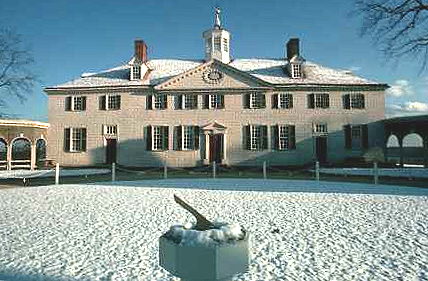 George Washington's Sundial is in the Spotlight: Sometime during 1765-1781 Washington placed a 12 inch brass horizontal sundial at the heart of his Mount Vernon plantation. The sundial sits atop a white painted octagon wood pedestal in the center of the front lawn of his mansion. It stands as a visual reminder of the importance of time to all who passed it. A replica of the original dial now reminds tourists of the time, but the original is in the museum. Go to https://www.georgewashingtonwired.org/ and read more about Mount Vernon and visit NASS Registry Dial 167 where you can find details of Washington’s dial.
- Details
- Hits: 19243
Oldest Sundial in the Western Hemisphere
 Drawing of La Fortaleza in San Juan Puerto Rico
Where would you look for the oldest dials in the Western Hemisphere? One is attributed to the Pilgrims in Salem in 1620. Earlier slate dials were used by Newfoundland fisherman. But La Fortaleza, in San Juan, the oldest Executive Mansion in the New World may lay claim to the oldest sundial.

- Details
- Hits: 10365
Sundial Rededication
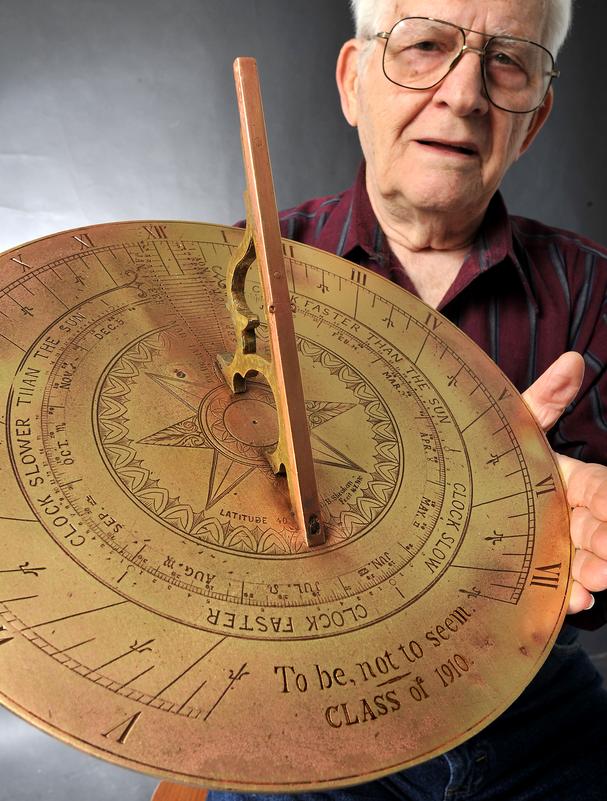 A sundial that was originally purchased by the 1910 class of Springfield (Ohio) High School and which adorned the original high school grounds for decades was recently refurbished and rededicated at the new Springfield High School.
Even though the dial adorned the school grounds for much of the 20th century, it eventually found its way into storage, where it remained until it was recently uncovered.
Unfortunately, a heavy patina on the copper dial rendered it nearly unreadable. So, the talents of retired engineer Don Pyles (class of '48) were required, who, after some initial experimentation, succeeded in restoring the dial's original appearance.
With a donation of approximately $1000, from the class of 1959, to cover some of the costs associated with installing it at its new location (e.g. to purchase a new pedestal), it is hoped future generations of high schoolers will continue to find the dial a unique and memorable gathering spot.
Read more at: http://www.springfieldnewssun.com/news/springfield-news/springfields-sundial-will-be-rededicated-1166758.html
- Details
- Hits: 12043
Rare Sundial Sold
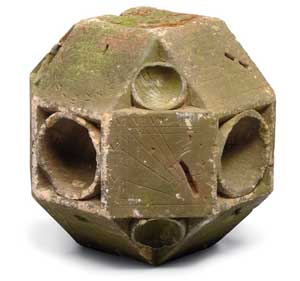 http://www.christies.com/A rare stone, polyhedral sundial discovered in England, and thought to date from the Scottish renaissance, sold April 7, 2011 for £16,250 ($26,500) at Christie's South Kensington, London.
The sundial discovered in 1974, and thought to date from the Scottish renaissance, went on the auction block this April as part of Christie's Travel, Science and Natural History sale in London. The dial is made of stone and technically described as a polyhedral dial, with several independent sundials arranged on different facets of the stone. Pre-auction estimates placed a value somewhere between £7000 and £10,000 ($11,400 and $16,300) but sold for nearly three times the initial estimate.
It is only by chance this dial was rescued from a potentially less illustrious end. The original owner found it partially buried in the ground in Herfordshire England, dug it up and used it as a garden ornament, even going so far as to grow strawberries in the scaphe dials (the semi-spherical "bowls" seen on the vertical faces in the image). After accompanying the owner during several house moves, a sundial enthusiast happened to see the unusual object and recognized it for the rarity that it is. A technical analysis of the dial locate its origin somewhere just south of Edinburgh sometime around 1630 to 1730. In the past twenty years, only two other examples of this kind of dial have come onto the market.
- Details
- Hits: 11489