
Founding Fathers
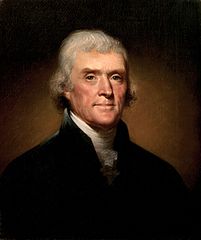 Thomas Jefferson by Rembrandt Peale-1800 White House Historical AssociationFred Sawyer, President of the North American Sundial Society and editor of the Compendium sundial journal will present a lecture on "Gnomonic Tales of Thomas Jefferson (and other Founding Fathers)" on Thursday evening, April 10th at 7pm at the Great Falls Library, VA. Reservations are required. Contact the Fairfax County Libraries for more information.
The lecture will consider sundials in the lives of Thomas Jefferson and other prominent figures of early America such as George Washington and Benjamin Franklin. Rather than serving simply as timekeeping devices, sundials will be seen as academic exercises, inspirations for poetry, symbols of an industrious new country, invitations to relaxation, and opportunities for invention.
Fred is a cofounder and the current president of the North American Sundial Society (NASS), and a vice president of the British Sundial Society. He is also the editor of The Compendium, having been responsible for each of the 80 quarterly issues to date. He has authored over 100 articles on gnomonics, and is a regular speaker at both NASS and BSS conferences. His interests lie primarily in theory, historical techniques for drawing dials, and new dial forms (including his own wandering gnomon, equant, compressed gnomonic, Ptolemaic coordinate, Foster point, and other varieties).
In 2000, Fred and his family instituted the Sawyer Dialing Prize awarded each year at the NASS conference to an individual for accomplishments in, or contributions to, dialing or the dialing community.
- Details
- Hits: 12292
Antique Sundial Treasures
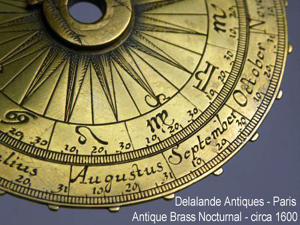 Gallerie Delalande, Louvre de Antiquaires, Paris The Galerie Delalande, Louvre des Antiquaires in Paris is presenting an exhibition of 150 Pocket and Table Sundials. The exhibit will continue until January 19th, 2014. The gallery is now offering a book "Cadrans solaires / Sundials", written in French and English to illustrate these sundials:. http://www.delalande-antiques.com/exhibition-sundials-paris/book-sundials.html
The Louvre des Antiquaires opened in 1978 and has a beautiful collection of astrolabes and nocturnals, globes and armillary spheres, octants, sundials and equinoctial rings and much more. You can find photos of many of these dials following the link http://www.delalande-antiques.com/marine-sciences/
- Details
- Hits: 14015
Building Gone - Dial Lives On
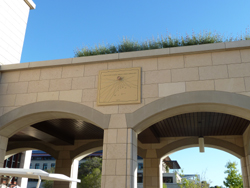
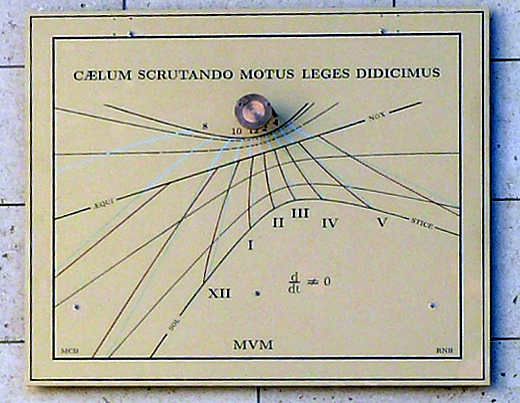 [photo courtesy of Kathleen Gust, Terman Engineering Library, Stanford Univ]In 1995 Professor Emeritus Bracewell designed a vertical declining dial for the south face of the Terman Engineering Building at his Stanford University home campus in Palo Alto. But the building was torn down in 2011 and by March 2012 nothing but landscaping of the new Terman Park remained. Fortunately Prof. Ronald Bracewell’s sundial once again casts its solar time on the south wall of the Stanford Jen-Hsun Huang Engineering Center. Both the Huang and old Terman building have similar south-south-west alignments allowing the dial to be remounted without adjustment. [http://library.stanford.edu/blogs/stanford-libraries-blog/2013/04/sundial-returns-engineering-center].
Bracewell described the sundial in the March 1997 issue of Stanford’s Civil Engineering Newsletter [http://www-ce.stanford.edu/Newsletter/archive/CENL0397.PDF ]. It is a vertical declining dial 15 degrees to the west, approximately 72 x 80 cm in size and made from aluminum In a plaque prepared by Bracewell and installed beneath the sundial, he states that his dial was modeled after the vertical dials that still faintly adorn the Tower of the Agora in Athens. The Tower of Agora, also known as the Tower of the Winds, was designed by Andronikos of Kyrrhos, and built in the early Roman period ~1st century BC.
Instead of a typical gnomon, Bracewell chose to use an oculus: a disc with a central hole. Standing 8 cm in front of the dial, the disc creates a shadow with a bright dot of sunlight in the center for telling both time and season. The hour lines are offset by 2 min 40 sec to account for the longitude of the Stanford campus and the hour lines themselves are laid out not as straight lines, but as analemma curves (the figure 8 pattern of the sun’s seasonal movement), with spring colored in green, summer in red, autumn in orange, and winter in blue. The analemma corrects for the “Equation of Time” allowing Bracewell to create an accurate clock-telling sundial.
The motto “Caelum Scruntando Leges Motus Didicmus” translates to “We learn the laws of motion by studying the heavens”. And with a bit of subtle math, “d/dt ≠ 0” on the dial plate, one could interpret this to mean “Time changes all things”. While Dr. Ronald N. Bracewell designed the sundial, his son Mark C. Bracewell constructed it. Both their initials can be found at the bottom of the dial.
Professor Ronald Bracewell of Stanford University was an early pioneer in radio astronomy applying his background of electrical engineering, ionospheric physics and radio wave propagation to the new realm of radio astronomy. He joined the Stanford faculty in 1955, where he ultimately held the Lewis M. Terman professorship. [Short biography at: http://news.stanford.edu/news/2007/november14/memlbrace-111407.html]
 [photo courtesy of Kathleen Gust, Terman Engineering Library, Stanford Univ]In 1961 he created an “X” array (called a “Chris-Cross array” for W.R. “Chris” Christiansen) of 32 10-foot diameter dish antennas to form a radio spectroheliograph nestled in the hills of Palo Alto, California. The radio telescope operating at a wavelength of 10cm produced daily maps of solar radio activity that NASA used during the Apollo moon landings. But Dr. Bracwell had other solar interests. He was a sundialist as well.
Between 1982 and1984 he designed a sundial for Stanford’s overseas campus at Villa Il Salviatino in Florence. Over a decade later now as Professor Emeritus Bracewell, he began the design of a vertical declining dial for the south face of the Terman Engineering Building at his Stanford University home campus in Palo Alto. In April 2013 it was remounted on the south bridgeway of the Jen-Hsun Huang Engineering Center. [photo courtesy of Kathleen Gust, Terman Engineering Library, Standford Univ.]
Bracewell’s radio telescope, now demolished, may have a second life as a sundial as well. The Very Large Array (VLA) of the National Radio Astronomical Observatory (NRAO) in New Mexico is planning a memorial to Dr. Bracwell who passed away in 2007. The plan is to create a horizontal gnomonic sundial at the entrance of the NRAO visitor center using the 6-foot antenna pillars from Bracewell’s early Stanford radio telescope. [You can support this effort at http://www.razoo.com/story/Bracewell ]
As a footnote, in January 1980 Dr. Woodruff (Woody) T. Sullivan III interviewed Prof. Ron Bracewell as part of a monumental documentation project of 225 founders of 20th century radio astronomy. The collection of interviews made by Sullivan during his 30 years of research for the basis for his book, Cosmic Noise: A History of Early Radio Astronomy (Cambridge University Press, 2009). [http://www.nrao.edu/archives/Sullivan/sullivan.shtml ].
- Details
- Hits: 15058
Historic Replica Dial for Holland College
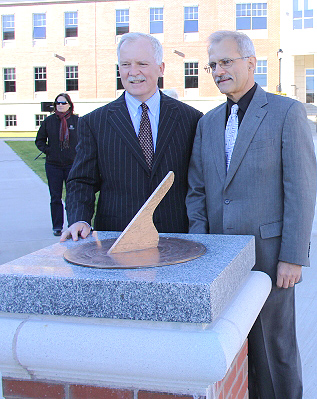 [Photo courtesy of Holland Colledge]In 2009 Holland College on Prince Edward Island began a major $17M renovation and expansion program, including a large open-space quadrangle. Vice President Michael O'Grady was commissioned Tony Moss of Lindisfarne Sundials [now retired] to make a replica sundial Captain Samuel Holland had given to Dartmouth College, New Hampshire in 1773. Tony undertook the work to create a copy of the dial, redeclinating it to the new site in Charlottetown in Prince Edward Island with the proviso that he "might replace the original ... chapter ring scrolls with some of my own design." Tony further commented, "I think the engraver was indulging an apprentice with the less-critical parts of the job..."
The full story of the making of this sundial will appear in the Bulletin of the British Sundial Society and in an article of The Compendium of the North American Sundial Society http://www.hollandcollege.com/news/news-archive/news-detail/?id=1669
Most colleges in Canada are named after the province in which they are located; but Holland College was named after Samuel Holland, who surveyed the province as part of his work on the Eastern Seaboard. In fact, there are many Holland descendants on the Island to this day.
Holland College has campuses across Prince Edward Island, but the majority of students are located in downtown Charlottetown, in what is now known as the Prince of Wales Campus (PWC). In 2009, Holland College announced a major campus redevelopment project, which included the construction of the $17 million Centre for Applied Science and Technology (CAST), the new Centre for Community Engagement (CCE), expansion of the college's residence, renovations to the Charlottetown Centre (the former PWC building), and the creation of more green space.
The green space, a quadrangle bordered by the CAST building, the Centre for Community Engagement, Glendenning Hall, and Grafton Street, was created to give students, staff and residents of the area a pleasant place to relax, and to create a more collegiate atmosphere for the college.
Vice President Michael O'Grady explained how a sundial became the centerpiece of the quadrangle: "One of the goals of the campus redevelopment project was to honour the historical significance of the location of the original campus, on land that was deeded to the province for educational purposes back in the early 1800s...
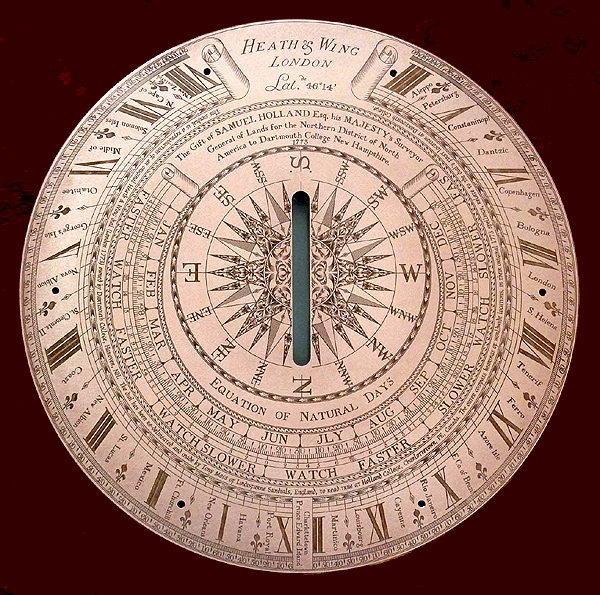 "Among the suggestions was a sundial, which I took upon myself to research. Gladly, that's when serendipity took over and, with several things on my mind on that day, I did a Google search on sundials AND Samuel Holland. Simultaneously. I don't know why ... but, I was utterly surprised and delighted when I came across a historical reference to an iconic and finely engraved brass sundial ...[engraved by the London firm of Heath and Wing ]... that had been presented to Dartmouth College in 1773 by none other than 'our' Samuel Holland, Surveyor-General of the Northern District of North America ... the man who made the map of this [Prince Edward] Island.
"Right away, I put in an inquiry with the Hood Museum of Art at Dartmouth College, a place I knew from previous visits to the campus, hoping that the sundial was still extant, but thinking it was a long shot. I was quickly connected with Dr. Kremer, who was pleased to inform me that the dial, a prized piece of his college's history, was indeed secured in their collections.
"Several months later, accompanied by my then 9-year old son, we traveled to Dartmouth College in search of this institutional treasure. I already had in mind that we would want to make a replica of it for the centerpiece of our own campus. When we viewed the dial in person, I was certain.
[Holland's gift of the 1773 Heath and Wing sundial is the earliest signed and dated instrument in Dartmouth College's King Collection of Scientific Instruments. As explained in a news article about the sundial, "Although Samuel Holland's reason for commissioning the sundial is unclear, legend at Dartmouth College is that he presented it as a token of his faith in the newly-formed institution.]
"Dartmouth College graciously agreed to a one-time reproduction and we commissioned Mr. Tony Moss, of Lindisfarne Sundials [now retired] in Northumberland, England, to reproduce the venerable Holland dial.
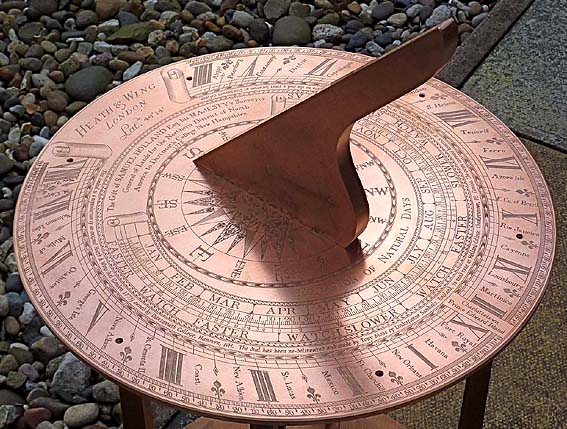 "Tony was recommended to the college by Jeff Lock of Colonial Instruments [an antique instrument restorer] in Ohio. Rich Kremer had phoned Jeff to see if it was a project that he would be interested in taking on. In another serendipitous twist, Jeff was already familiar with Holland College, as I had been in communication with him several times regarding images of period survey instruments for our website.
[And by even more luck, Jeff had been in correspondence with Tony.] As Tony recalls, "It was Jeff Lock of Colonial Instruments who persuaded Holland College to approach me. Jeff and I had useful correspondence over my Mariners' Astrolabe and it was then that he saw what photo-etching can achieve."
Vice President O'Grady continues, "Jeff called me to discuss the project, and at that time told me that he felt the best man for the job would be Tony Moss. Tony spent many, many hours working on our sundial, and more than a few emails flew back and forth across the Atlantic as the work progressed.
- Details
- Hits: 13562
Ivory Diptych Sundial Unearthed at Jamestown
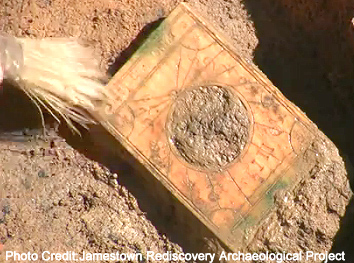 [photo courtesy of the Jamestown Rediscovery Archaeology Project]At historic Jamestown, Virginia, the first successful English colony in the New World, a rare 17th century ivory sundial was found during recent excavations. You can read about it in Popular Archaeology June-2012
A small ivory diptych sundial was discovered during the Jamestown Rediscovery Archaeological Project dig of soil where a cellar stood as part of the early James Fort. The pocket dial was crafted by Hans Miler, most probably of Nuremberg, Germany. You can see a similar Nuremberg Diptych Sundial from Metropolitan Museum of Art made by Hans Troschel the Elder. http://www.metmuseum.org/toah/works-of-art/03.21.38
Michael Lavin, Senior Conservator of the Jamestown Rediscovery Archaeological Project used a Serle Dialing Ruler made by the North American Sundial Society (NASS) to measure the hour lines of the diptych dial, concluding the dial’s latitude was made for approximately 53 degrees. Visit http://www.historicjamestowne.org/the_dig/ and view the unearthing of the dial in the video below:
- Details
- Hits: 15436
Dial 'Down Under' Acquired by Historical Museum
 [photo credit: Port Macquarie Historical Society]
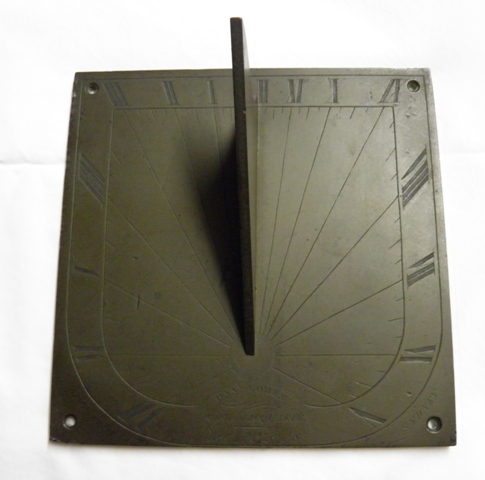
 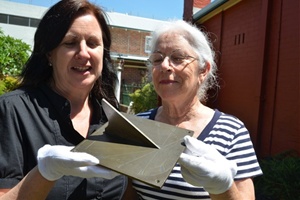 [photo credit: Port Macquarie Historical Society]The words “sundial” and “convict” are not often used in the same context,but that is the situation in Port Macquarie, Australia when a vintage sundial made around 1840 was put on permanent display at the Port Macquarie Historical Museum. The dial was made by colonial engraver Raphael Clint and was once owned by Danial Cohen, who, convicted in 1830 of receiving stolen property in Lancaster, was sent to Port Macquarie, a penal colony at the time.
Read more about the history of this dial at: http://www.portnews.com.au/news/local/news/general/sundial-link-to-past/2361551.aspx
- Details
- Hits: 12472