
...until the last syllable of recorded time
 With all due respects to Shakespeare, time will always be with us, and signifies quite a lot. The Harvard-Smithsonian Center for Astrophysics is organizing a symposium dedicated to Time and Culture to be held 5-9 June 2016 at Harvard's Northwest Lab. According to the symposium organizers:
"The symposium aims to set the stage for future timekeeping standards, infrastructure, and engineering best practices for astronomers and the broader society. At the same time the program will be cognizant of the rich history from Harrison's chronometer to today's atomic clocks and pulsar observations. The theoreticians and engineers of time will be brought together with the educators and historians of science, enriching the understanding of time among both experts and the public."
The definition of the second has changed several times over the last 40 years and likely will change again before the end of this decade. Should timekeeping be decoupled from the rotation of the earth? We already abstract time with zone time (such as Eastern Standard Time) and minipulate it to fit our activities (using Eastern Daylight Saving Time). We no longer worry about the moment of sunrise or sunset, rather that we go to work at 9:00AM or have a class that lasts from 10:00-10:50AM. Indeed, "ante and post meridian" may be obsolete.
"The future of timekeeping is evolving with the development of optical frequency standars, the consideration of high-order relativistic effects, and the challenges of distributing trusted timescales at even higher preicision....A closer look at time in astronomy and other sciences, as a defining element of modern civilization, is needed."
- Details
- Hits: 10658
Greenwich Globe
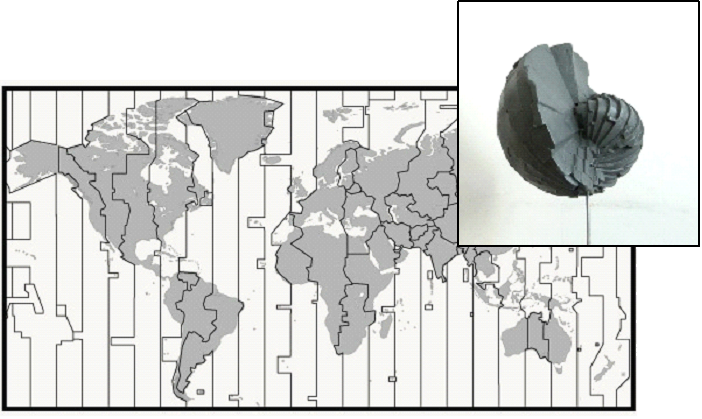
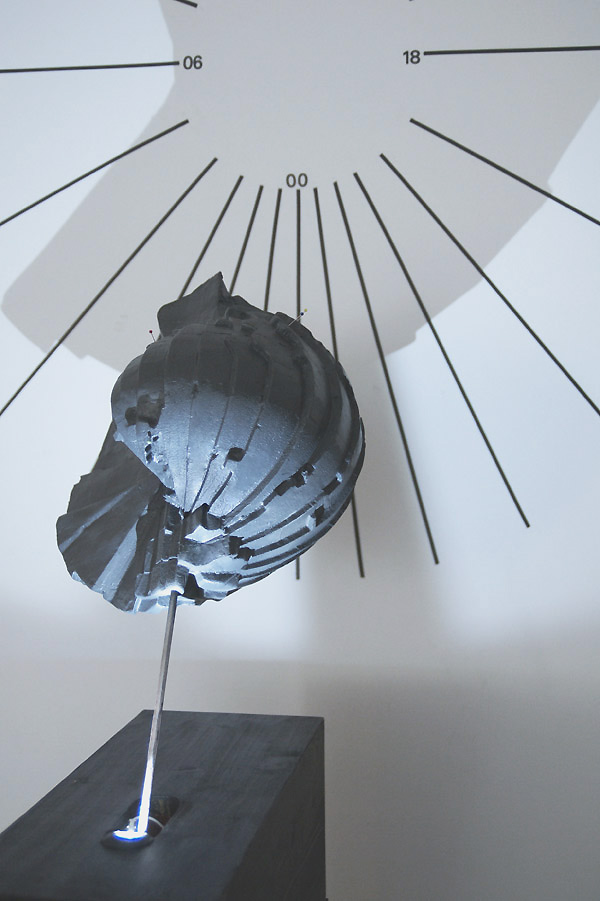 Greenwich Globe - Alisa GoikhmanAlisa Goikhman has put into art a sculpture called the Greenwich Globe. What started as a simple idea of dividing Canada and the US into time into time zones 15o wide (one hour steps), today's meridian boundaries create a complicated map. Goikhman projects this map onto a globe with the ragged ridges of each time zone, sequentially enlarging the meridians using the proportions of an Archimedes spiral.
Goikhman explains: " The Greenwich Globe's shape was generated by an algorithm that treated time as physical matter. Each additional hour is represented through a constant degree of elevation and a 15o angle bend. The elevation based map projections gives easy-to-read shape to the complex man-made system of time-zones. It also operates as a sundial, a play on the now familiar row of world time clocks. The shadow it casts on a wall is meant to be read as a world watch. Each spike in the shadow shows the local time at a corresponding geographical region."
The idea of time zones began in 1879 with Sir Sandford Fleming, Chief Engineer of the Northern Railway Grand Trunk Railway proposing time zones at the 75th 90th, 105th and 120th west meridians from Greenwich. A mathematician can easily divide the globe into 24 uniform zones of 15o shifting time sequentially by one hour. But politics and trade intrests have intervened around the globe, shift time zone boundaries to national interests, resulting into an intricate pattern of time shifts, some only 30 minutes wide. This goes back to the 1884 International Prime Meridian Conference held in Washington, D.C.
Alisa Goikhman's representation of these varied time zones is quite striking. At her website you can see more images of the Greenwich Globe and a video briefly but accurately explaining world time zones. http://alisagoikhman.com/projects/greenwich_globe/ You can also find her video on this website at http://www.sundials.org/index.php/dial-links/videos?start=20
The use of time zones was almost immediately adopted by the railway companies in Canada and the United States, agreeing upon Fleming's time zone proposal on November 18, 1883. It simplified the train schedules of arrival and departure times from municipalities along the routes. Within a year the system proved so successful that it prompted the United States Congress to formally authorize the President to hold an international conference for the purpose of “fixing upon a meridian proper to be employed as a common zero of longitude and start of time-reckoning throughout the globe”.
 In October 1884 the International Prime Meridian Conference was held in Washington, D.C. At the time of the conference each nation used their own Prime Meridian. For example a number of US state boundaries were defined in terms of the prime meridian of the United States. In 1890 a Meridian Stone was set in the center of the Ellipse in front of the White House intended to be on the same meridian as that defined by Thomas Jefferson in1793 and marked by Jefferson's Pier in 1804. Officially, on September 28, 1850 the US Congress established that “...the meridian of the [Naval] observatory shall be adopted and used as the American meridian for all astronomical purposes and … the meridian of Greenwich shall be adopted for all nautical purposes.”
France would have liked the Paris observatory to be the international meridian since it was the basis for more than 2600 hydrographic charts. Fleming, one of the British delegates, pointed out that based on the number of international ships and tonnage, “It thus appears that one of these meridians, that of Greenwich, is used by 72 percent of the whole floating commerce of the world, while the remaining 28 percent is divided among ten different [national] meridians.”
Countering this, French delegate Mr. Lefaivre argued that the meridian should be chosen on scientific grounds, not on national interest. Others, including Fleming, were in favor of a “neutral” meridian for the start of the universal day to be situated 180 degrees from Greenwich because “it does not cross any continent” and “it coincides exactly with that line where, after the custom introduced by a historical succession of maritime discoveries, the navigator makes a change of one unit in the date.”
Mr. Juan Pastorin, delegate of Spain, proposed:
- We agree to choose as the prime meridian for cosmic time that meridian near which the civil day of the world commences, namely, the anit-meridian [180 degrees away from]f Rome, Greenwich, or Havre.
- The cosmic day consist of 24 hours and commences at midnight of the prime meridian.
- The earth is divided from the initial meridian into twenty four hour spaces [zones], counted in a direction contrary to the movement of the earth from 0hr to 24 hr.
After a recess, the vote was taken. It lost. Other proposals were made such as “...recommending the mean noon at Greenwich as the commencement of the universal day” that was and is the common practice of astronomers to this day (now called the Julian Day). Others suggested the international date change at Greenwich midnight. Another interesting resolution by France, was the decimalization of both time and angle. That resolution passed unanimously, but it seems that the decimal time system has never caught on.
After much heated debate the 1884 Conference resolved in the Final Act:
- That it is the opinion of this Congress that it is desirable to adopt a single prime meridian for all nations in place of the multiplicity of initial meridians which now exist.
- That the Conference proposes to the Governments here represented the adoption of the meridian passing through the center of the transit instrument at the Observatory of Greenwich as the initial meridian of longitude
- That from this meridian, longitude shall be counted in two directions up to 180 degrees, east longitude being plus and west longitude minus.
- That the Conference proposes the adoption of a universal day for all purposes for which it may be found convenient, and which shall not interfere with the use of local or other standard time where desirable.
- That this universal day is to be a mean solar day; is to begin for all the world at the moment of mean midnight on the initial meridian, coinciding with the beginning of the civil day and date of that meridian; and is to be counted from zero up to twenty four hours.
- That the Conference expresses the hope that as soon as may be practicable the astronomical and nautical days will be arranged everywhere to begin at mean midnight.
- That the Conference expresses the hope that the technical studies designated to regulate and extend the application of the decimal system to the division of angular space and of time shall be resumed, so as to permit the extension of this application to all cases in which it presents real advantages.
While Sir Sandford Fleming lobbied for the use of time zones separated at 15 degrees (that is, at one hour intervals), it was not approved at the 1884 Conference. Ultimately standard time, using the railway adopted time zones, was officially established in the United States with the Act of March 19, 1918, called the Standard Time Act. The act also established daylight saving time in the nation for support of the Great War (World War I). Daylight Saving Time was repealed in 1919, but Standard Time using time zones has remained the law ever since.
Read more at:
- Details
- Hits: 17198
A History of the Sky
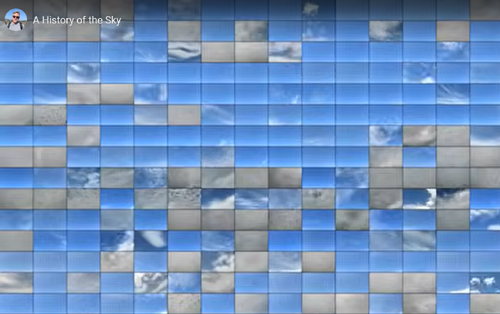 Kevin Murphy, artist and photographer, set up a time-lapse camera on the roof of the San Francisco Exploratorium to record the sky every 10 seconds, 24 hours per day for an entire year. The camera points due north at and elevation of 45 degrees, which means that you won’t see any dramatic sunrise or sunset, nor will you see a burning image of the sun. Even with the wide-angle lens, the sun is always kept just out of view. But what a wonderful view of the sky: Look closely at the video and you’ll see moving clouds, fog, rain, and differing colors of the sky.
Most stunning is the changing length of the day. Summer morning twilight begins about 4:10am (Pacific Standard Time) and evening twilight ends about 8:10pm, but you must be patient for the winter sky to appear. Winter morning twilight begins about 6:50am (PST) and evening twilight ends about 5:30pm. (There’s a small running clock in the bottom right corner to chart your progress). You’ll see the dramatic difference between summer and winter with days in darkness patiently waiting their turn at sunrise and conversely, the fast quenching of the blue sky into darkness well before the summer frames show any sign of paling.
Each frame is digitally photographed at 1024x768 pixels, that with compression, requires about half a terabyte storage per year. Kevin Murphy has been creative with the sky display: Thumbnail videos of each day of the year are collectively represented in a tiled mosaic 20 days wide by 18 days tall, showing 360 days of sky all at once. The images are arranged chronologically, and are synchronized by time of day, beginning before summer sunrise. Time is compressed in playback at 24 frames/second so that each second represents 4 minutes of time.
This is still a work still in progress: As the camera on the Exploratorium roof continues to collect images of the sky, they will be integrated into the daily montage. Therefore the video will vary from day to day, always displaying the most recent 365 days.
Visit http://www.murphlab.com/hsky/ for more information.
- Details
- Hits: 16708
Virtual Art for Inventor of Standard Time
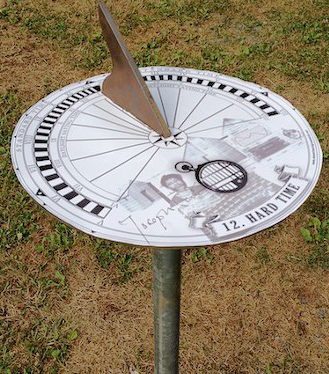 A new sundial project called “Meantime in Greenwich” opened on “Dingle Day” August 6th in Sir Sandford Fleming Park (affectionately known as “Dingle Park”) located in the Halifax Regional Municipality of Nova Scotia. Media artist David Clark created a series of 24 horizontal sundials that surround the Memorial (Dingle) Tower, a site that once had been Fleming's summer home. Visitors to the public exhibit can download a free app onto their phone or iPad and hear an audio story when they approach each sundial. For iPhone users, aiming its camera at the sundial triggers a 3D object to appear on the screen. As Clark describes it, “Each sundial becomes a pedestal for virtual reality. Everybody becomes their own cinema.”
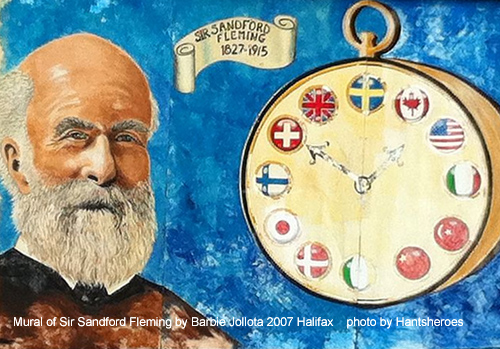 The public art project honors Sir Sandford Fleming, Chief Engineer of the Northern Railway Grand Trunk Railway who devised standard time. His original idea was Cosmic Time, what we now call Universal Time that is independent of longitude. In 1879 he proposed that time be linked to the anti-meridian of Greenwich (180o longitude) and lobbied for the use of time zones at the1884 International Prime Meridian Conference in Washington, D.C. “What he did was wean us away from solar time - he developed the 24 time zones,” said Clark, “I thought an ironic monument to him would be to place 24 sundials across the park.” If one looks closely at these sundials, the hours are labeled in both “Standard Time” and “Daylight Saving Time” with a small graph of the Equation of Time to translate local solar time into Atlantic Zone Time.
Read more about the phone apps, the 24 sundials and about Sir Sandford Fleming, inventor of Standard Time:
- Details
- Hits: 15478
2012 Transit of Venus
NASA has taken outstanding video of the June 6th 2012 transit of Venus. Images were recorded by the NASA Solar Dynamics Observatory Satellite that records the sun's surface and corona at a number of visible light and ultraviolet wavelengths. [See sdo.gsfc.nasa.gov] These images showing the 2012 transit of Venus were recorded at a wavelength of 171 Angstroms (AIA 171) (Extreme Ultraviolet). This channel is especially good at showing coronal loops - the arcs extending off of the Sun where plasma moves along magnetic field lines. The brightest spots seen here are locations where the magnetic field near the surface is exceptionally strong.
- Details
- Hits: 13799
Sundial WebCam In Action
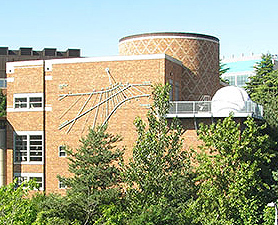
Want to watch a sundial in action? Professor Woodruff Sullivan and Ian Smith at the University of Washington in Seattle have just launched an active webcam of the University’s large vertical declining sundial on the side of the Physics and Astronomy building. The webcam image is updated once per minute day and night. “we know that some of you will want to stare at it for hours on end (or at least bookmark it….”
Their website has many features including the first two time-lapse movies of the giant sundial showing the all-day shadow on the summer solstice and on the autumn equinox. More time lapse videos will be presented during the months that come. In the near future they will improve the present camera with higher-resolution and greater reliability.
A flurry of sundial webcams existed in 2004-05 when the EarthDial Project, the invention of Bill Nye and Woody Sullivan, was run under the auspices of The Planetary Society. The Project, with a motto Two Worlds, One Sun was run in conjunction with the MarsDial Project, which involved the Mars Exploration Rovers Spirit and Opportunity, each of which landed on Mars in 2004 with a small calibration target turned into a Mars sundial on its deck. People around the world were urged to build sundials of a standard design and display them to the world using a webcam. Click Here to See Time Lapse Movies of Some of These Dials. A new Mars sundial will arrive red at the red planet next August onboard Curiosity.
Take a look at the new webcam at http://sunny.astro.washington.edu
- Details
- Hits: 17019