
2007 Conference - McLean
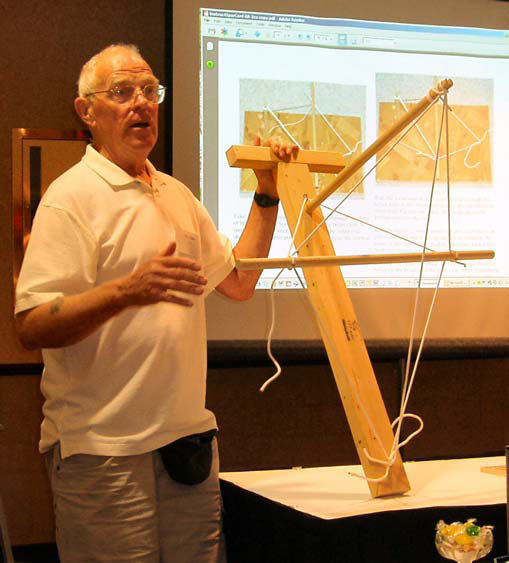 Mac Oglesby Demonstrates Rope and Spar DialIn McLean, Virginia close to Washington, D.C. NASS held its 13th annual conference. At the Analemma Society’s site in Observatory Park, Tony Moss’ dial, the “Jamestown Commemorative Dial,” was dedicated in front of over 50 school children and twice as many adults. This is the first sundial installation in what is planned to be an International Sundial Garden. Other highlights of the sundial tour included the Lyman Briggs Memorial Dial at the National Institute of Science and Technology, the Latitude Observatory (once used to study the daily variation in the earth’s wobble and rotation rate), the Vernon Walker Education Center dial, and the vertical dial on the wall of Jack and Kate Aubert. The conference talks included Roger Bailey on “God’s Longitude and the Lost Colony,” Woody Sullivan’s “Ten Tons of Basalt and Tenths of Degrees,” Fred Sawyer’s discussion on the 17th century battle over the priority of inventing the stereographic quadrant dial, Kevin Karney’s “Variability in the Equation of Time” over geological epoch periods (well, for at least 500 years), and much more. Most impressive was Julian Chen’s “Omnidirectional Lens in Sundials and Solar Compasses” using spheres filled with solution of copper sulfate to focus the sunlight onto a dial.
Learn about the history of the Briggs Sundial:  BriggsDial.pdf
Download the retrospective: 2007_NASS_Conference_McLean_VA.pdf
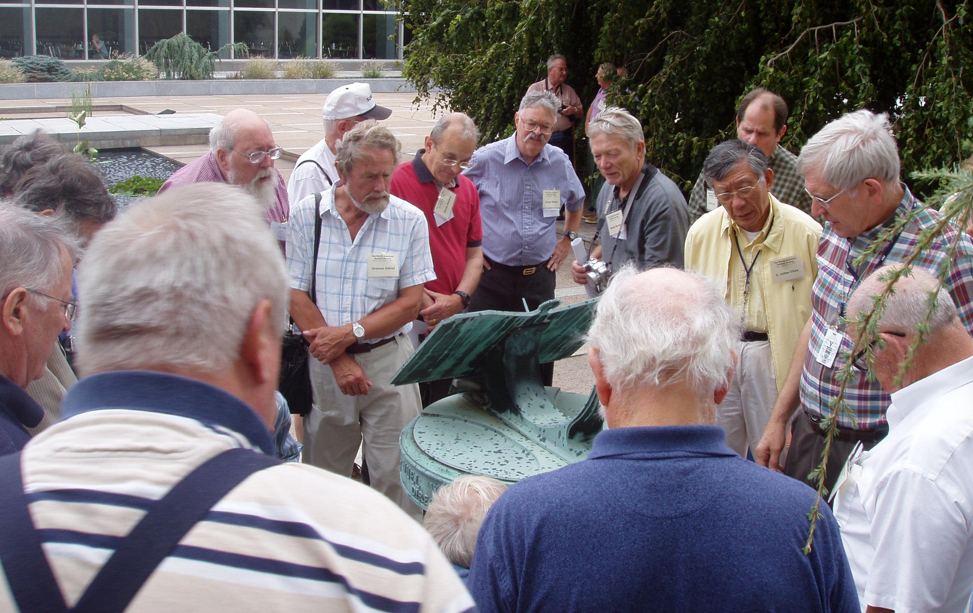 NASS Attendees at NIST Briggs Sundial in Maryland
- Details
- Hits: 9352
2006 Conference - Vancouver
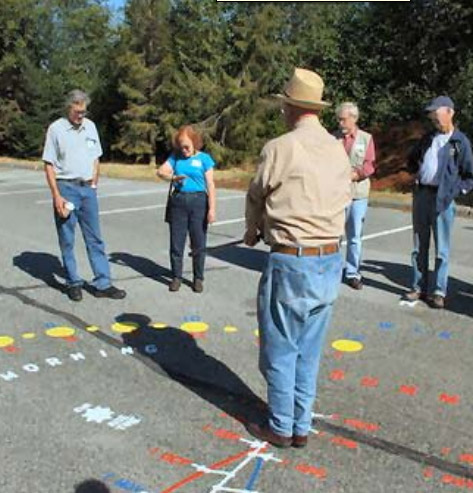 Albinson Slpit Analemmatic SundialArt meets science: John Carmichael held a workshop on DeltaCAD, a flexible computer aided design program for designing sundials and later in the conference with “Some New Sundials I” showed the result of such designs in beautiful stain glass sundials. From the history domain, Fred Sawyer told the story of Captain Sturmy, a 17th century mariner and author of “Gnomonical Scales,” now part of the Shadow Catchers series. Len Berggren discussed the sundials of Geminos of Rhodes in his text “Introduction to the Phenomena,” written about the first century BCE. Chuck Nafziger showed his light concentration sundial with Braille markings to show time-telling to the vision impaired, and Professor Woody Sullivan displayed a prototype of the One-World-Two-Suns Mars sundial. On the pavement of the parking lot, Brian Albinson drew out the split-analemma analemmatic sundial.
See these sundials and more … download the PDF: 2006_NASS_Conference_Vancouver.pdf
- Details
- Hits: 8958
2005 Conference - Chicago
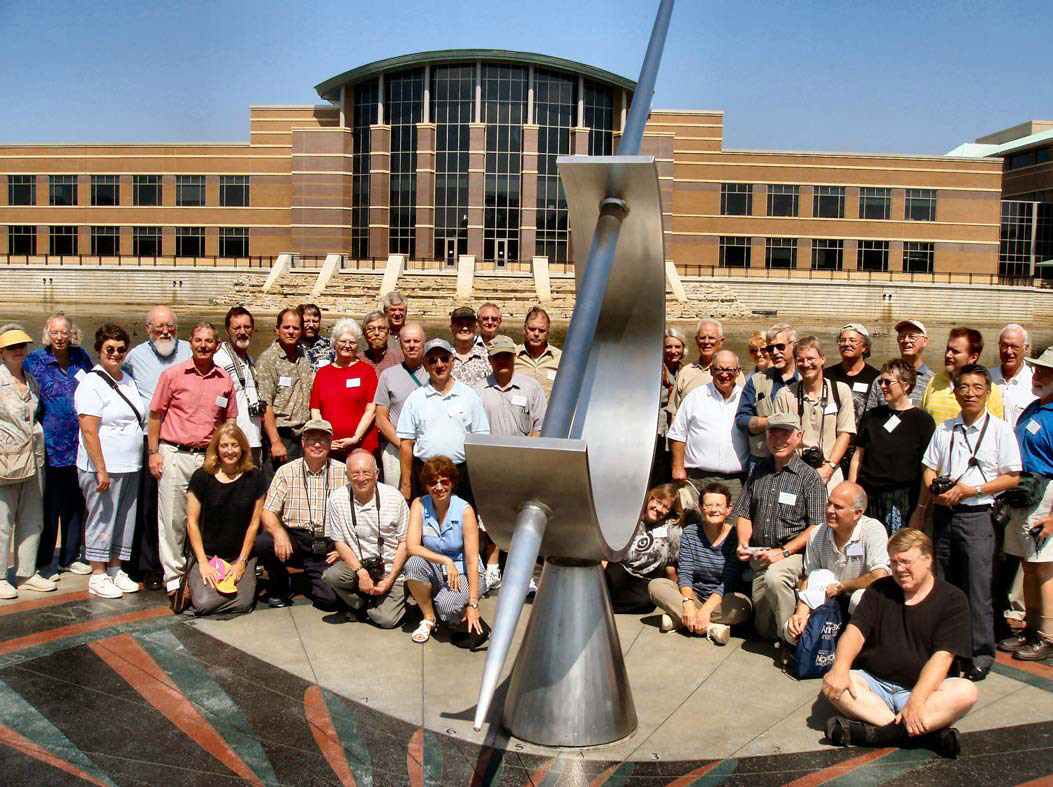
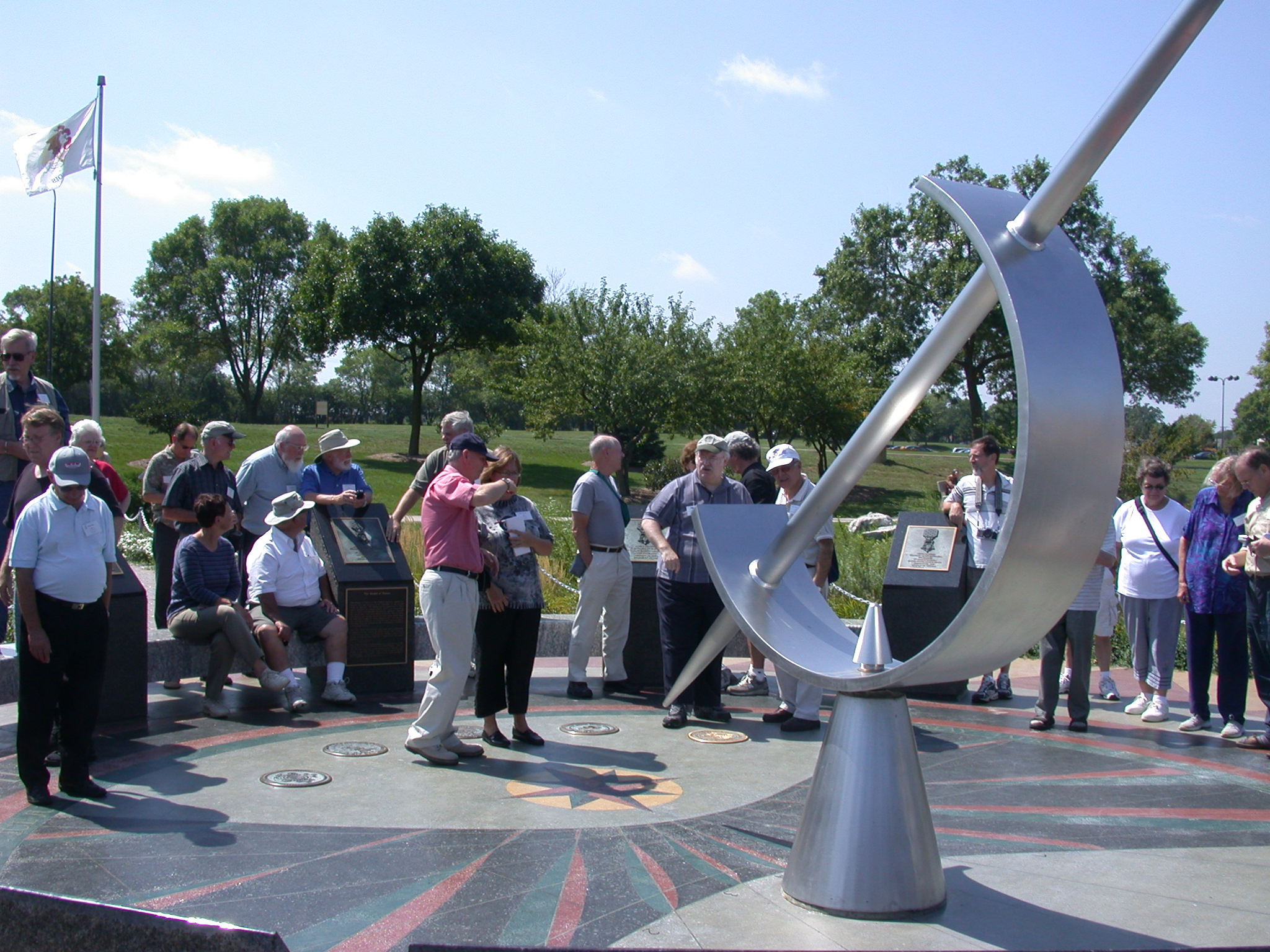 NASS Attendees Inspect Wheaton Memorial Sundial This conference contrasted the old and the new. Steve Luecking presented “Rope Geometry”, an outdoor exercise to draw an ellipse on the ground and draw a horizontal dial using only a knotted cord and stakes in the fashion of ancient Egyptian “rope pullers” (civil engineers). When the conferees visited the Museum of Science and Industry, they were able to see a collection of dials, including a fine example of a first century AD dial, a slight variant of a hemisphaerium. Klau Eichholz talked about Fr. Franz Xaver Josef Bovius and the restoration of his 1716 dial at Solnhofen. On the modern fron, Mike Shaw led the group carefully through the steps of understanding and creating the ingenious Universal Diallist’s Companion. By special arrangement, Fred Sawyer distributed copies of this very useful device to everyone in attendance. Fred then introduced another new dial of his devising, the Hectemoros Dial. Tony Moss discussed two power point presentations “Using and Understanding Sundials” and “Concepts for Students of Sundialling”. A highlight of the conference was the announcement that the North American Sundial Society had been asked to be technical advisor on sun shadows for an episode of the television series “NUMB3RS.” Plus many other presentations by Larry McDavid, Don Petrie, Roger Bailey and a workshop on 3D CAD by SteveLuecking.
Download the retrorespective: 2005_NASS_Conference_Chicago.pdf
- Details
- Hits: 9294
2004 Conference - Tenafly
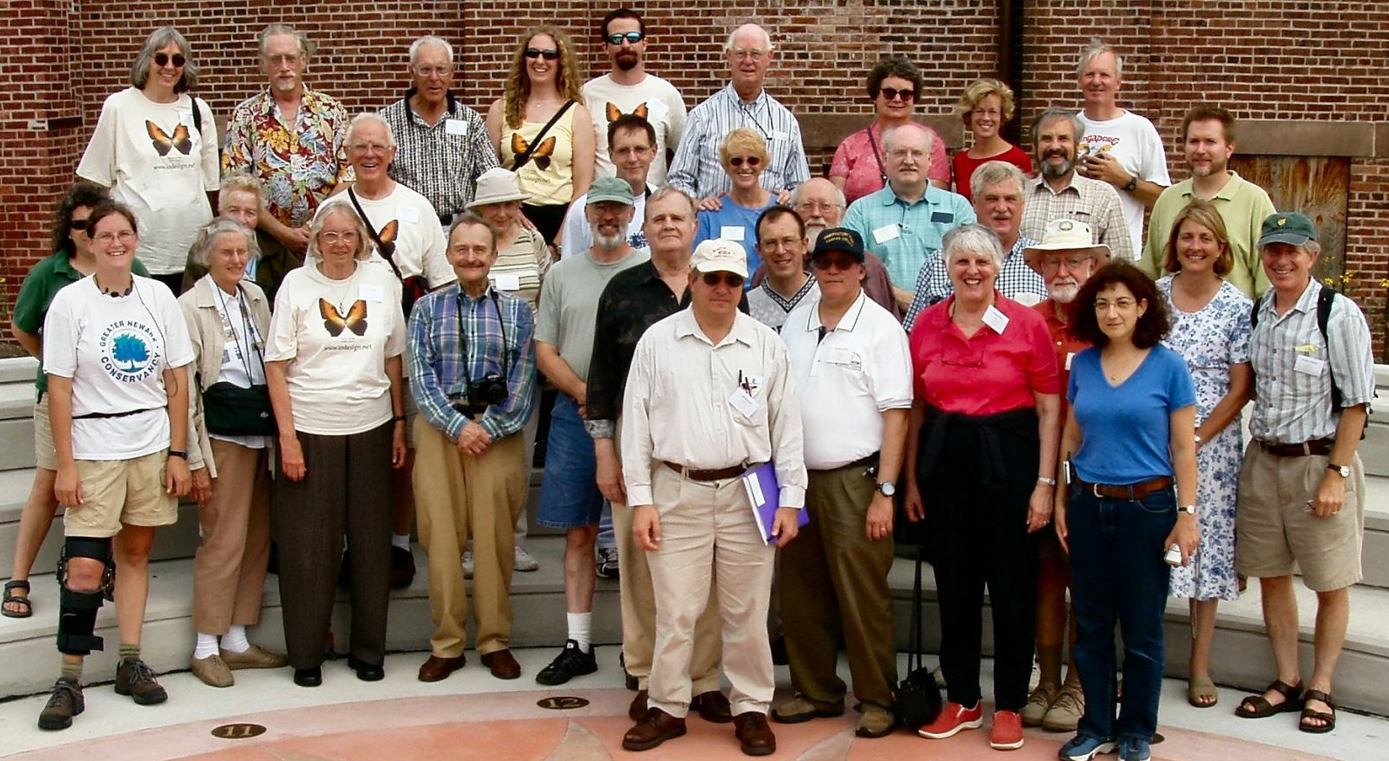
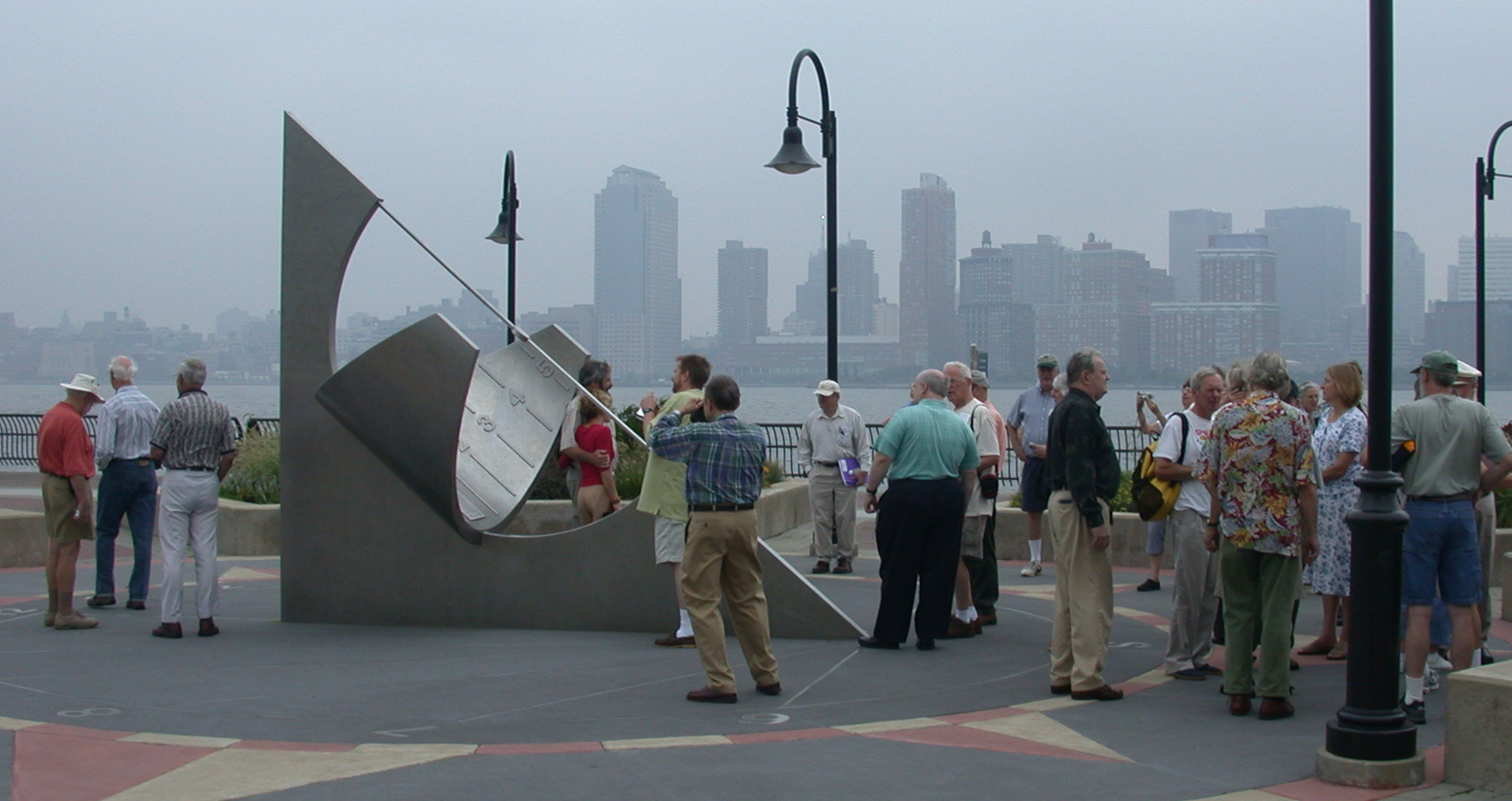 At Tenafly, New Jersey NASS conferees once again to discuss sundials and sundial making. Larry McDavid began the conference with “Sundials: Prehistory to the Digital Age” intended as an instructional power point that can be given to a wide spectrum of adult audiences. A companion presentation, “Beauty in Dialing” is also released for educational use. Bob Kellogg discussed construction and alignment of the Freedom High School 9-11 memorial Dial. Bob Terwilliger “in a blaze of entertaining wizardry” described Bion’s 17th and 18th century techniques for dial construction usin his laser trigon “sciatorium.” Bob showed how his precision instrument that can “draw a sundial on a Buick” also can design a dial on his garden hot-tub. Steve Luecking demonstrated programs for deriving hour lines and day lines from shadow planes and other CAD techniques. Plus many more interesting presentations by Bill Gottesman, Robert Adzema, Martin Jenkins, John Carmaichael, and Sara Schechner.
Download the retrospective: 2004_NASS_Conference_Tenafly.pdf
- Details
- Hits: 12819
2003 Conference - Banff
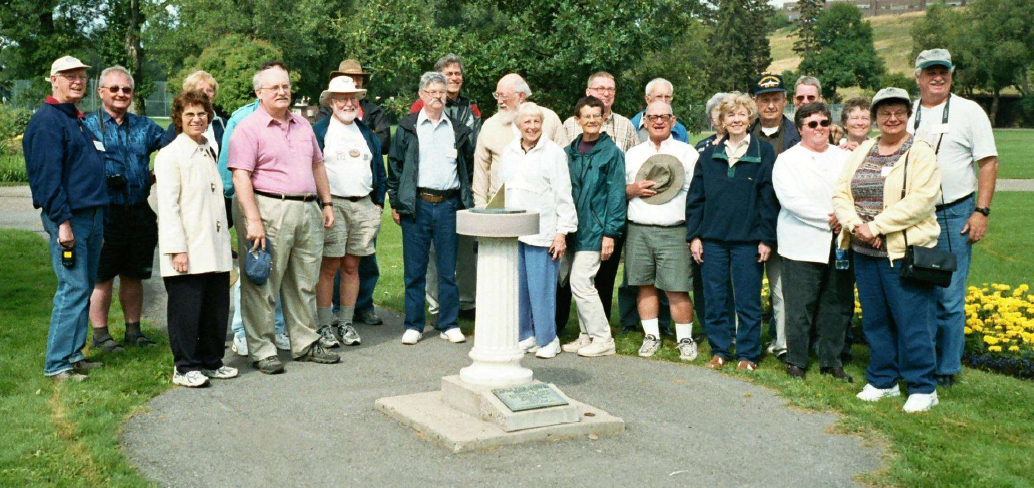
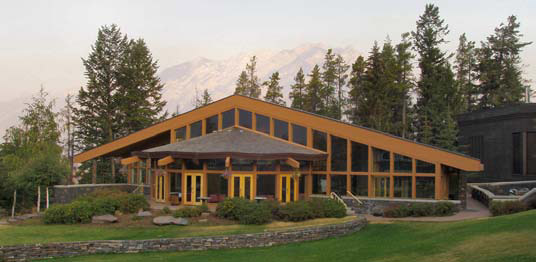 Thirty Nine NASS members met in the beauty of the Canadian Rockies at the Banff Conference Center. Talks began with Roger Bailey explaining his approach to “Designing a Sundial from Scratch” using basic trigonometric formulas. Then Fred Sawyer described the 19th century French engineer Charles-Nicolas Peaucellier who published a type of dial using only straight lines. Among other presenters was Tom Kreyche with “Projections of the Sphere for Universal Astrolabes. The center of attention came when Paul Nibley presented a variety of sundials with alarms. Everyone was delighted to watch his noonday cannon remind us of the sun on the meridian. Also demonstrated was a butterfly sun alarm that spread its wings with a chime, powered by solar cells. Tony Moss, UK dialist, discussed his efforts toward working with stainless steel. Roger Bailey discussed astro-archeology from the Stone Age the the Mayans and the Renaissance. Later, Dr. Gordon Freeman, Albertan scholar, presented his research on the Majorville Medicine Wheel. These are only some of the fine papers presented.
Download the retrospective: 2003_NASS_Conference_Banff.pdf
- Details
- Hits: 8858
2002 Conference - Tucson
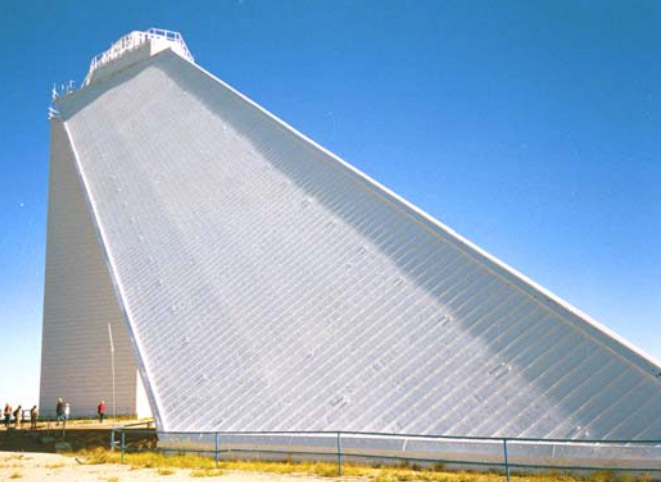 McMath-Pierce Solar Telescope at Kitt Peak
The skies were clear for the NASS conference in Tuscon, Az. Conferee speakers received a replica of the “Fugio” cent, America’s first coin issued in 1787. This coin was designed by Benjamin Franklin and shows a sundial with the motto “Fugio” meaning “Time flies”. Continuing the historical theme, Len Breggren discussed the history of sundials to 200 BCE and the work of the Greek geometer Diocles, who described the earliest Greek sundial, a hemispherical mirror that indicated the hour of the day from burning a trace. Fred Sawyer discussed the overlap of Dialing and Cartography. John Schilke’s presentation "Oh, East Is East and West is West" was a note on the Prime Vertical, that great circle which passes through the zenith and nadir and the east and west points of the horizon. The Prime Vertical is thus orthogonal to the meridian and to the horizon. Bill Walton presented “Pinholes and Shadow Sharpening” and Bill Gottesman presented a method for measuring wall declination using a carpenter’s square. Saturday’s sundial tour started at the Kitt Peak National Observatory, home of the world’s largest collection of optical telescopes (in 2002) and John Carmichael discussed how one might turn the McMath-Pierce Solar Telescope into a sundial.
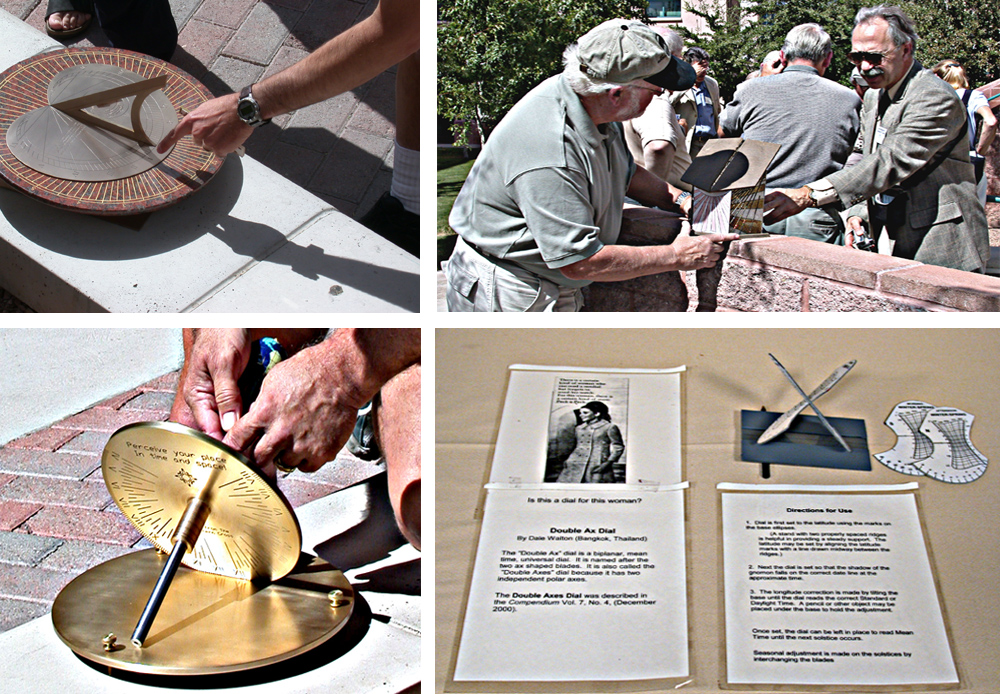
Carl Haskett showed off his well crafted patented SunClock design, a pair of semi-cylindrical polar dials adjustable for latitude, longitude and equation of time. When set for the location, the SunClock will show clock time of day and the approximate day of the month. Claude Hartman demonstrated a model of his award winning sundial structure that incorporates ten separate sundials. These dials can be read on the walls and inside the stained glass structure. Bill Walton displayed an analemmatic “Sun Compass” and an interesting Pelekinon double axis sundial.
Here is the complete retrospective: 2002_NASS_Conference_Tuscon.pdf
Below: (Clockwise from upper left) Bill Gottseman demonstrates his Sawyer Equant Dial; Dudley Warner and Len Berggren discuss Claude Hartman's model of his dial structure; Walton's Sun Compass and Pelekinon double axis sundial.
- Details
- Hits: 8870